Your first one-card draw: drawing, reading and recording
The best way to improve at tarot is a daily one-card draw. Let’s practise, step by step, how to frame a good question, how to look at the card and how to keep a record.
On this page
(Beginner · about 4 minutes to read)
If you think you must learn all 78 meanings before you read, you will never get started. What many teachers recommend is to draw one card a day and spend the day with it. Joan Bunning, too, makes recording a daily card the foundation in her beginner’s guide. With only one card the load is light, and if you keep it up for a year you will meet each card many times.
1.A good question is an open question
The cards answer “how can I…?” and “what should I watch for?” far more richly than yes-or-no questions. Making yourself the subject also makes it easier to turn the answer into action.
2.Rephrasing questions
- ✗ “Does he like me?” → ✓ “What should I value to help my relationship with him grow?”
- ✗ “Will my job change succeed?” → ✓ “What should I be looking at now as I think about changing jobs?”
- ✗ “Will I pass the exam?” → ✓ “What attitude should I take in the time before the exam?”
- For a daily card: “What should I be aware of today?” or “What is today’s theme?”
3.How to draw
There are no strict rules. What matters is to follow the same steps each time, calmly. If you draw on a website, take a breath before you press the button and put your question into words in your head once.
4.The basic steps
-
- Settle your question in one sentence and write it down.
-
- Breathe deeply and shuffle while holding the question in mind (on a site, press the draw button).
-
- Turn one card face up.
-
- Before opening the encyclopedia, look at the picture for 30 seconds and write down what you notice and feel.
-
- Check the keywords in the card encyclopedia and set them against your own impressions.
-
- Decide on one concrete action for today.
5.Why look at the picture before the book
If you read the keywords first, it tends to turn into memorising. If you look at the picture first and notice which way the figure faces, whether it is bright or dark and what they hold, the meaning stays with you in your own words. With the Page of Cups, for example, the young person gazing at the cup held up before their chest should naturally suggest “feelings just beginning to stir”.
6.Three cards that are easy to read from the picture
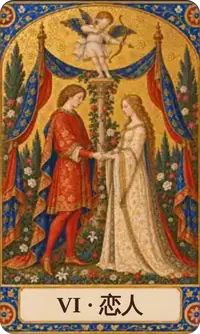
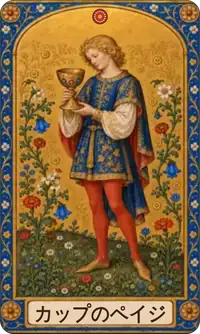
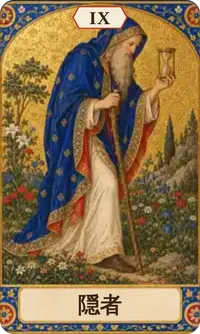
The Lovers, the Page of Cups and the Hermit. Just looking at the figures’ expressions, hand movements and where they are looking gives you a feel for them. Before checking the encyclopedia, try summing up your impression in a word.
7.Keeping a record
A record is the shortcut to progress. A notebook or the notes app on your phone will do. Adding a one-line review at night ties the card’s meaning to real events, and grows “your own dictionary”, something no textbook can give you.
8.Record template
- Date and question
- The card you drew (upright or reversed)
- Your first impression of the picture
- The keywords from the encyclopedia that struck a chord
- Today’s action
- Night review: when during the day did you think of the card?
9.When the same card keeps coming up
As you keep up a daily draw, the same card may appear again and again. Take it as a nudge: “look at this theme a little more”. It may be chance, but if it helps you notice something you need to work on, the time was well spent.
10.An example draw
Say you ask in the morning, “What should I be aware of today?” and draw the Two of Swords. In the picture, two curved blades cross around the stem of a single flower, held in a tense balance at the point where they meet (in the Waite deck, a blindfolded figure crosses two swords in front of their chest, with a calm sea and the moon behind). Your first impression is “someone who can’t make up their mind and is keeping their feelings locked away”. So you note the day’s theme: “No need to decide in a hurry. But a day to gather information without looking away from my true feelings.” In your night review you add one line: in a meeting you avoided answering on the spot, checked the documents first, and it went well. Lines like this, piling up, grow “your own Two of Swords”, one no dictionary holds. A common mistake is to read one keyword and stop there. Think of the one-card draw as running all the way to linking the picture with your day and writing a line about it.
11.Practice
For the next seven days, use the one-card draw in the tarot reading to ask “What should I be aware of today?” and record it with the template above. On the seventh day, read back through and look for suits that came up often, or days with a similar mood.
12.Quiz
Q1. Which question suits tarot?
- Does he like me?
- What should I value for my relationship with him?
- Will I get married next year?
Answer: What should I value for my relationship with him? An open question with yourself as the subject is easy to turn into action, and lets you read more from the card’s picture.
Q2. What should you do first after drawing a card?
- Look at the picture and write down what you feel
- Draw again if you don’t like it
- Memorise the meaning in the encyclopedia right away
Answer: Look at the picture and write down what you feel. Looking at the picture first and putting your impression into your own words fixes the meaning in your memory and widens your reading.
Q3. What is the main purpose of the night review?
- To predict tomorrow’s card
- To score whether it came true
- To tie the card’s meaning to real events and grow your own dictionary
Answer: To tie the card’s meaning to real events and grow your own dictionary. The review isn’t a score sheet; it deepens your understanding by linking meanings to experience.
13.Draw a card
Yorozu Goyomi’s tarot reading lets you do a one-card draw, a three-card spread, an either-or reading and the Celtic Cross, free and with no sign-up. Look up the meanings of all 78 cards in the tarot card encyclopedia.
Now try a reading for yourself
Free readings related to this article.
Read next