Reading reversed cards: four patterns

A card that comes up upside down, a “reversal”, is not necessarily the opposite of the upright meaning. Using four patterns, weakened, delayed, inward and excessive, makes your reading far more natural.
On this page
(Elementary · about 4 minutes to read)
When you turn a card over, the picture is sometimes upside down. This is called a reversed card. Many beginners picture “reversed = a bad meaning”, but that is a misunderstanding. It is easier to think of a reversal as a state in which the upright energy “isn’t flowing straight”. Reversals aren’t in tarot’s oldest layer, though. The 15th-century Milanese cards were for play, and reversed meanings first appear in print in the writings of Etteilla: first in 1770 for a 32-card piquet deck, then in the 1780s for tarot. Mary K. Greer, in a book devoted to reversals, set out several patterns for reading them. Drawing on her ideas, here are four patterns that are easy to use in practice.
1.Four patterns of reversal
- Weakened: the upright meaning isn’t fully expressed, or has stalled halfway.
- Delayed: the event may happen, but not yet; preparation is needed.
- Inward: it is happening not in outside events but inside the heart, on a personal level.
- Excessive: the upright quality has gone too far and is upsetting the balance.
2.Comparing them with one card
Take the Sun reversed. Upright, it is brightness, joy and success. Weakened: “there is joy, but under a slightly cloudy sky”. Delayed: “success is a little further off”. Inward: “others can’t see it, but there is a small joy in your heart”. Excessive: “so optimistic you aren’t watching your step”. None strays far from the Sun’s meaning, and none is wholly negative.
3.Cards for the examples
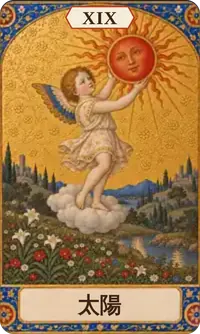
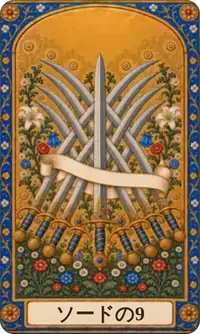
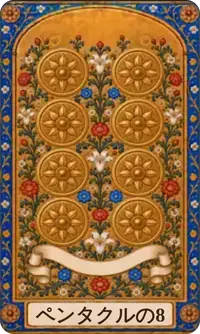
The Sun, the Nine of Swords and the Eight of Pentacles. Get the upright meaning firmly in mind, then think which pattern fits.
4.Reversals of harsh cards
Cards with a harsh meaning upright are often read reversed as “that hardship easing”. The Nine of Swords, for example, shows anxiety so bad you can’t sleep, but reversed it can be read as “getting past the peak of anxiety” or “feeling better after confiding in someone”. There is also an inward reading, “pushing anxiety deep inside”, so judge by the question and the surrounding cards.
5.Which pattern to choose?
When in doubt, think in this order. First, set the readings against the theme of the question and see which is most natural. Next, look at the surrounding cards: if many are full of momentum, “excessive” often fits; if many show stagnation, “delayed” or “weakened”. Finally, choose the reading that speaks most to your heart. Your first intuition is surprisingly often right.
6.Some schools don’t use reversals
In fact, quite a few readers don’t use reversals at all. Many Marseille readers and some others read every card upright and bring out nuance through combinations and positions. That is a perfectly good method too. As a beginner, it is also a good idea to get used to all 78 upright first and add reversals later. In Yorozu Goyomi’s tarot reading, switch off “include reversals” before you start and you can read everything upright, Marseille-style.
7.The right frame of mind
A reversal is not a “warning” but “a hint for adjustment”. If energy is blocked, where can you loosen it? If it has gone too far, where can you ease off? A reversal is exactly when you get advice that leads to concrete action. Don’t be afraid; face it as a question.
8.Example: the Eight of Pentacles reversed
Say you ask “How should I go about studying for my qualification?” and draw the Eight of Pentacles reversed. Upright, it is a craftsman carving coins one by one, steadily honing a skill. Weakened: “motivation won’t hold, and you keep stopping”. Delayed: “it will take a little longer before results show”. Inward: “you are making the effort but can’t give yourself credit for it”. Excessive: “demanding perfection, you fuss over details and the whole doesn’t move”. If the person asking is at their desk late every night, the excessive reading fits. The advice: “a little every day, rather than perfection”. A common mistake is to read the reversal as the exact opposite of the upright and declare “your effort will be wasted”.
9.Practice
Choose a card you like in the encyclopedia and, from its upright meaning, make your own reversed reading for each of the four patterns. When you have finished, compare them with the encyclopedia’s reversed meaning and see which pattern it is closest to.
10.Quiz
Q1. Which best describes a reversal?
- It is always a bad meaning
- A state in which the upright energy isn’t flowing straight
- A sign that you must redo the reading
Answer: The upright energy isn’t flowing straight. A reversal isn’t the simple opposite of the upright; read it as a change in how the energy flows: weakened, delayed, inward or excessive.
Q2. Reading the Sun reversed as “so optimistic you aren’t watching your step” is which pattern?
- Inward
- Excessive
- Delayed
Answer: Excessive. It is the upright brightness gone too far.
Q3. What is true of reading without reversals?
- Beginners must learn reversals first
- Official tarot forbids it
- A perfectly good method, common in the Marseille tradition and elsewhere
Answer: A perfectly good method. Many schools read every card upright and bring out nuance through combinations and positions.
11.Draw a card
Yorozu Goyomi’s tarot reading lets you do a one-card draw, a three-card spread, an either-or reading and the Celtic Cross, free and with no sign-up. Look up the meanings of all 78 cards in the tarot card encyclopedia.
Now try a reading for yourself
Free readings related to this article.
Read next