What is tarot? From card game to a tool for reading
Tarot began as a card game in 15th-century Italy, and over several hundred years grew into a tool for divination and reflection. Knowing its history makes your relationship with the cards much freer.
On this page
(Beginner · about 5 minutes to read)
When you hear “tarot”, you may picture a mysterious secret book handed down from ancient times. The real history is a little more down to earth and human. This lesson traces roughly where tarot came from and how it took its present form. Knowing the history is also the first step to freeing yourself from the belief that there is only one right way to read.
1.It began as a card game for nobles
The oldest surviving tarot cards were painted for the court of Milan around the 1440s, and at about the same time the name trionfi appears in records from Ferrara and Florence (the earliest document is the 1440 diary of Giusto Giusti, a notary of Anghiari in Florentine territory, followed by records of the court of Ferrara in 1442). The most famous are the lavish hand-painted cards made for the Visconti and Sforza families of Milan. The best known of these, the Visconti-Sforza deck (around the 1450s, traditionally attributed to the workshop of Bonifacio Bembo), is thought to have had 78 cards, of which 74 survive, divided between the Morgan Library in New York, the Accademia Carrara in Bergamo and private collections. The Devil, the Tower, the Three of Swords and the Knight of Coins (Pentacles) are lost. At the time they were called trionfi, “triumphs”, and were made for a trick-taking game: the usual four suits plus a set of trump cards painted with allegorical pictures. These trumps are what later became the Major Arcana. In other words, tarot was originally a plaything.
2.It became a tool for divination in the 18th century
In late 18th-century France, the scholar Court de Gébelin claimed that tarot was a book passing on the wisdom of ancient Egypt. The theory is now considered to have no historical basis, but it left a great mark. Around the same time, a man calling himself Etteilla published a guide to tarot divination (1783–85) and then, at the end of the 1780s, a tarot deck made specially for divination, and the culture of reading the future and the heart with cards spread. Inspired by Court de Gébelin’s idea, Éliphas Lévi in the mid-19th century linked the 22 cards with the 22 letters of the Hebrew alphabet and placed tarot inside a system of magic and esoteric thought.
3.The Marseille deck: a simple, powerful tradition
In 17th- and 18th-century France, a family of woodblock-printed decks known as the “Tarot de Marseille” (a name that only caught on in the late 19th and 20th centuries) was widespread. The Major Arcana are allegorical figures, while the numbered cards of the Minor Arcana are simple designs showing the right number of wands, cups and so on. Because the numbered cards show no scenes, later readers, especially 20th-century French authors, developed a “numerological” way of reading that combines the meaning of the number with the nature of the suit. Many readers, above all in Europe, still treasure this tradition.
4.The Waite deck: a story for all 78 cards
In 1909, a deck edited by A. E. Waite, a former member of the British esoteric society the Hermetic Order of the Golden Dawn who then led his own offshoot, and illustrated by the artist Pamela Colman Smith, was published by Rider. This is the “Rider-Waite” (or Waite-Smith) deck. Its great innovation was that even the numbered cards of the Minor Arcana show figures and scenes, so you can imagine their meaning just by looking at the picture. (Putting scenes on numbered cards had already been tried in the Italian Sola Busca deck of around 1490, and Smith is thought to have consulted photographs of it; its influence is clear in the Three of Swords and the Ten of Wands.) Most tarot decks sold around the world today are based on these designs, and Yorozu Goyomi’s tarot card encyclopedia follows its order and names. In the Waite deck, Justice, number 8 in the Marseille deck, and Strength, number 11, swap numbers (the Golden Dawn made the swap, and the Waite deck was the first to print it and spread it).
5.The two cards whose numbers swapped
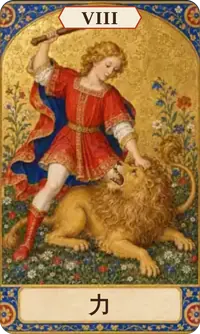
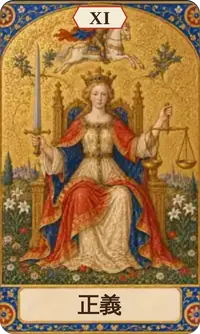
In the Waite deck, Strength is 8 and Justice is 11. They are the other way round in the Marseille and Thoth decks, so when you use another deck, check by the picture and name rather than the number.
6.How tarot is made up
Tarot has 78 cards in all, divided into two main groups.
7.The 78 cards
- Major Arcana: 22 cards, from 0, the Fool, to 21, the World. They stand for the big themes and turning points of life.
- Minor Arcana: 56 cards, four suits (Wands, Cups, Swords, Pentacles) of 14 cards each. They stand for everyday events and the movements of the heart.
- Within the Minor Arcana: 40 numbered cards from Ace to 10, and 16 court cards (Page, Knight, Queen, King).
8.Tarot is not a tool for fixing the future
Leading modern writers such as Rachel Pollack and Mary K. Greer treat tarot not as something that pronounces your fate but as a mirror that reflects your situation and helps you think about your choices. What the cards show is the tendency if things carry on as they are, or a point of view you had missed. What you do once you have the result is always your choice. Yorozu Goyomi’s tarot reading holds to this idea too.
9.Common misconceptions, and what we know
- “Tarot comes from ancient Egypt” → A theory spread in the 18th century, with no support in the sources. The oldest surviving cards are from 15th-century Italy.
- “The Roma people passed it down as fortune-telling” → A story often told in the 19th century, but again without firm evidence.
- “It had 78 cards from the start” → Early decks varied in make-up by region and period; 78 became standard only later.
- “A deck you buy yourself won’t work” → Just a saying. You are free to choose a deck you like.
10.Practice
Open the card encyclopedia and compare the pictures of 0, the Fool, and 21, the World. What impression do the beginning and end of the journey give you? Note it down in a word; it will come in handy in Lesson 3.
11.Quiz
Q1. Where were the oldest surviving tarot cards made?
- Ancient Egypt
- Northern Italy in the 15th century
- England in the 19th century
Answer: Northern Italy in the 15th century. Tarot began as cards for a game at the courts of northern Italy around the 1440s. The Egyptian theory was put forward in the 18th century and has not been confirmed.
Q2. What is the big feature of the Waite deck?
- The numbered cards of the Minor Arcana also show scenes
- It has 100 cards
- It has no Major Arcana
Answer: The numbered cards show scenes. Because even the numbered cards have figures and scenes, it is easy to imagine their meaning from the pictures. This is one reason the deck spread around the world.
Q3. How many cards does tarot have in all?
- 78
- 22
- 56
Answer: 78. The standard deck is 22 Major Arcana plus 56 Minor Arcana, 78 cards in all.
12.Draw a card
Yorozu Goyomi’s tarot reading lets you do a one-card draw, a three-card spread, an either-or reading and the Celtic Cross, free and with no sign-up. Look up the meanings of all 78 cards in the tarot card encyclopedia.
Now try a reading for yourself
Free readings related to this article.
Read next