The court cards: how to read the sixteen figures
The sixteen Pages, Knights, Queens and Kings are the cards beginners stumble over most. Grasp their character as “rank × suit”, then read them in one of three ways: as a person, as a side of yourself, or as a situation.
On this page
(Elementary · about 4 minutes to read)
There are four court cards in each suit, sixteen in all. Because they show people, it is easy to wonder, “Does this mean someone?” In fact there are several ways of reading them. The trick is to grasp the character of each rank first, then read the card to suit the situation it appears in.
1.The four ranks
- Page: starting to learn, curiosity, news, openness. Not much experience yet, but plenty of room to grow.
- Knight: action, movement, pursuit. The drive to charge towards a goal; sometimes extremes or haste.
- Queen: receptiveness, inner maturity, the power to nurture. Understands the suit’s power deeply inside and supports others.
- King: leadership, responsibility, outward expression. Masters the suit’s power and influences those around.
2.Building a character from rank × suit
You can read all sixteen by multiplying the rank’s character by the suit’s element. The Queen of Cups, for example, is “someone who takes in feelings (water) deeply inside”, so she becomes a highly empathetic, good listener with sharp intuition. The King of Swords is “someone who masters thought (air) and turns it outward”: a fair, logical leader who sometimes makes stern judgments. The Knight of Wands is “a doer who charges on passion (fire)”, and the Page of Pentacles “someone who has begun to learn practical things step by step”.
3.Comparing their characters
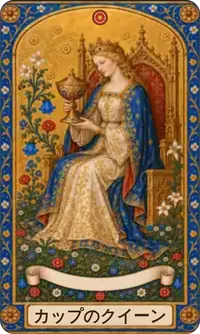
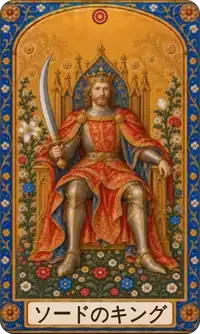
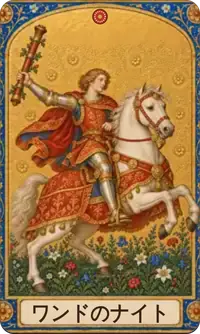
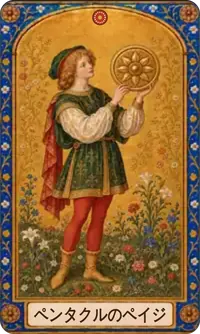
The Queen of Cups, the King of Swords, the Knight of Wands and the Page of Pentacles. Their expressions and postures show their elements too.
4.Reading 1: as a real person
When they appear in a question about love or relationships, you can read them as the other person or the people around you. There is no need to stick to sex or age, though: a Queen can stand for a man and a King for a woman. What to look at is “how that person is behaving”.
5.Reading 2: as a side of yourself
When they appear in a question about yourself, take them as the qualities of that figure within you. The Knight of Swords might ask “am I rushing to conclusions?”, and the Page of Cups might say “try expressing your honest feelings”.
6.Reading 3: as a situation or event
They can also show how things will move, rather than a person. The Page as news or a small beginning, the Knight as a sudden move or travel, the Queen as a time to receive things calmly, the King as a time to take charge and decide. The Page in particular is often read as “a message arrives”.
7.When you can’t decide which
Judge from the question and the meaning of the position. In a “their feelings” position, read a person; in an “advice” position, a side of yourself; in “how things will unfold”, a situation. That feels natural. Mary K. Greer, too, says the court cards come alive when read not as one fixed meaning but as “the role being called for now”.
8.Going deeper with the elements (a bridge to intermediate)
In the Golden Dawn system, the ranks have elements too. The usual pairing is Page = earth, Knight = fire (or air), Queen = water, King = air (or fire). The elements of the Knight and King swap between schools, so for now it is enough to know that this reading exists. In the Thoth deck, the ranks themselves are Knight, Queen, Prince and Princess.
9.A common mistake
Quite a few people read a court card as a prophecy that “someone is about to appear”. If the Knight of Cups comes up in a question about work, for example, reading it as a side of yourself or a situation, “go along with a proposal you are genuinely interested in”, often fits the question better than “someone wonderful will appear”. Keep reading them as people mainly for when the question or position points to “someone else”. The next lesson has a quick-reference table for reading all sixteen in the three ways.
Next: Reading the 16 court cards as a person, as yourself and as a situation
10.Practice
Choose one court card that “seems like me” and one that “seems like someone close to me”. Explain where the likeness lies, using the words of the rank and the suit.
11.Quiz
Q1. What does a Page often stand for?
- Starting to learn, or news
- Complete authority
- The end of a cycle
Answer: Starting to learn, or news. The Page shows curiosity and the beginning of learning, and as a situation is often read as “news arrives”.
Q2. Which best describes the Queen of Cups?
- Highly empathetic; takes in feelings deeply
- A doer who just charges ahead
- A logical leader who makes stern judgments
Answer: Highly empathetic. The Queen is receptiveness and inner maturity, and the Cups are water’s feelings; together they make a figure rich in empathy and intuition.
Q3. Which is true of reading court cards?
- Court cards aren’t used in readings
- A King always means an older man
- They can be read as a person, a side of yourself or a situation
Answer: They can be read in those three ways. Without fixing on sex or age, read them as a real person, a side of yourself or the way things move, depending on the question and position.
12.Draw a card
Yorozu Goyomi’s tarot reading lets you do a one-card draw, a three-card spread, an either-or reading and the Celtic Cross, free and with no sign-up. Look up the meanings of all 78 cards in the tarot card encyclopedia.
Now try a reading for yourself
Free readings related to this article.
Read next