Common doubts, answered

Is it all right to redraw for the same question? What should you do when a scary card comes up? How should you think about tarot being right or wrong? Answers to the doubts everyone runs into while learning.
On this page
(Intermediate · about 4 minutes to read)
As you keep practising tarot, a different kind of doubt appears, one that has less to do with memorising meanings and more to do with your frame of mind. Here we take up questions many people have, and answer them with the views of different readers in mind.
1.Q. Can I redraw for the same question again and again?
Redrawing straight away isn’t really recommended. If you keep drawing until the answer you want comes up, you end up searching for your own wishes rather than listening to the cards. On the other hand, there is no problem drawing again once the situation has changed, or after leaving it for a few days to a week. And if the answer was unclear, rather than repeating the same question, ask a different one, such as “one more card to help me understand this card better”, and draw for that.
2.Q. A scary card came up. What should I do?
Death, the Tower, the Devil and the Ten of Swords are cards whose pictures easily make people anxious. But none of them is “a warning of unavoidable misfortune”. Death stands for an ending and rebirth, the Tower for an old framework collapsing so that what is real can be seen, and the Devil for becoming aware of attachments that tie you down. Scary cards are also the ones that light up a truth you didn’t want to see but needed to. When one comes up, ask yourself: “To make this situation better, what can I let go of, and what can I change?”
3.Cards that look scary but matter
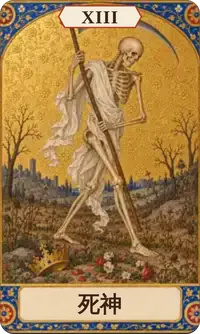
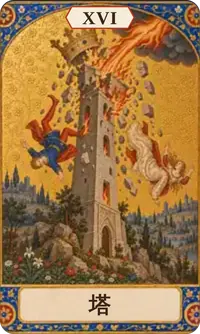
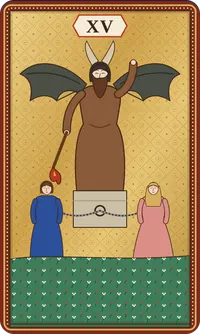
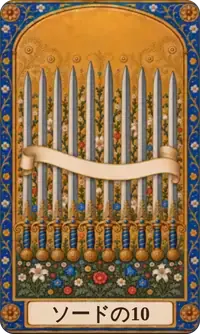
Death, the Tower, the Devil and the Ten of Swords. Each of them moves you on to the next stage through an “ending” or a “realisation”.
4.Q. Is tarot accurate?
There are many views about how tarot works. Some explain it psychologically: a card that turns up by chance brings out a theme that was already in your mind. Others feel a more mystical connection. What every view shares is that the cards let you see your situation from a new angle. If you judge tarot only by whether it was right, you are disappointed when it misses and lean too heavily on the result when it hits. If you value “what did this reading help me notice?”, tarot becomes a tool that serves you for much longer.
5.Q. If a bad future comes up, is it fixed?
No, it can change. What tarot shows is the tendency if things carry on as they are. If a result worries you, take it as a signal that “now is the time to change the current”. Draw one more card for advice and think about what concrete action you can take.
6.Q. Can I read for other people?
Reading for someone’s sake is fine. But most readers consider it bad manners to pry into someone’s secrets or inner feelings when they aren’t there. When someone is on your mind, make yourself the subject of the question: “How should I relate to this person?”
7.Q. I can’t remember the meanings. Am I just not cut out for this?
Don’t worry at all. Nobody memorises all 78 cards straight away. Professional readers keep learning too, going back to card dictionaries and guidebooks. If you keep up a one-card-a-day practice, the meanings settle in naturally. What matters is not how much you memorise but how often you sit with the cards.
8.Mottos for when you’re unsure
- Rather than redraw, wait a while or change the question.
- Scary cards tell you what to let go of.
- Count what you noticed, not hits and misses.
- The future is a tendency. Actions can change it.
9.Q. I find myself doing readings many times a day
The more anxious you are, the more you want to keep drawing. That is a natural feeling, but drawing again and again to check the answer only deepens your confusion. As a rule of thumb, leave at least a few days between readings on the same theme, and ideally wait until the situation moves. In the meantime, the surest way forward is to act on one piece of advice from the cards you already drew. Tarot is not a tool that makes decisions for you; it is a tool that gathers the material for you to decide for yourself. If painful feelings go on, please also make a point of talking to someone you trust, or to a support service.
10.Q. What are clarifiers, jumpers and “cleansing” a deck?
A clarifier is an extra card some readers draw when a position is hard to understand. Read it not as a new answer but as a footnote to that one card. A “jumper” is a card that flies out of the deck while you shuffle. Many readers pay attention to them, but that is a habit, not a rule. “Cleansing” a deck (tapping it lightly, resting it beside a crystal, shuffling it from scratch) is a personal ritual, not an established tradition. On this site, all 78 cards are freshly shuffled before every draw.
11.Practice
Pick one card that has come up for you and felt “scary” or “confusing”, and ask it: “What is this card telling me to let go of?” Write down whatever comes to mind in three lines.
12.Quick quiz
Q1. When an answer is unclear, what is the recommended response?
- Redraw for the same question until the answer you want appears
- Ask a different question and draw one extra card for clarification
- Throw the cards away
Answer: Ask a different question and draw one extra card for clarification. Repeating the same question tends to turn into searching for your own wishes. Changing the question to “one more card to clarify” deepens your understanding.
Q2. What is a positive way to take the Tower?
- An old framework collapses and what truly matters comes into view
- A sign that you should give up tarot
- A great misfortune will certainly happen
Answer: An old framework collapses and what truly matters comes into view. The Tower shows change that comes with a shock, but it also means a false foundation crumbles and the truth becomes visible.
Q3. What approach to tarot does this course recommend?
- Follow the result in everything
- Judge it only by whether it was right
- Value what the reading helped you notice
Answer: Value what the reading helped you notice. Rather than fixating on hits and misses, focusing on what you noticed makes tarot a tool for reflection that serves you for a long time.
13.Draw a card
Yorozu Goyomi’s tarot reading lets you do a one-card draw, a three-card spread, an either-or reading and the Celtic Cross, free and with no sign-up. Look up the meanings of all 78 cards in the tarot card encyclopedia.
Now try a reading for yourself
Free readings related to this article.
Read next