The meaning of numbers: Ace to Ten
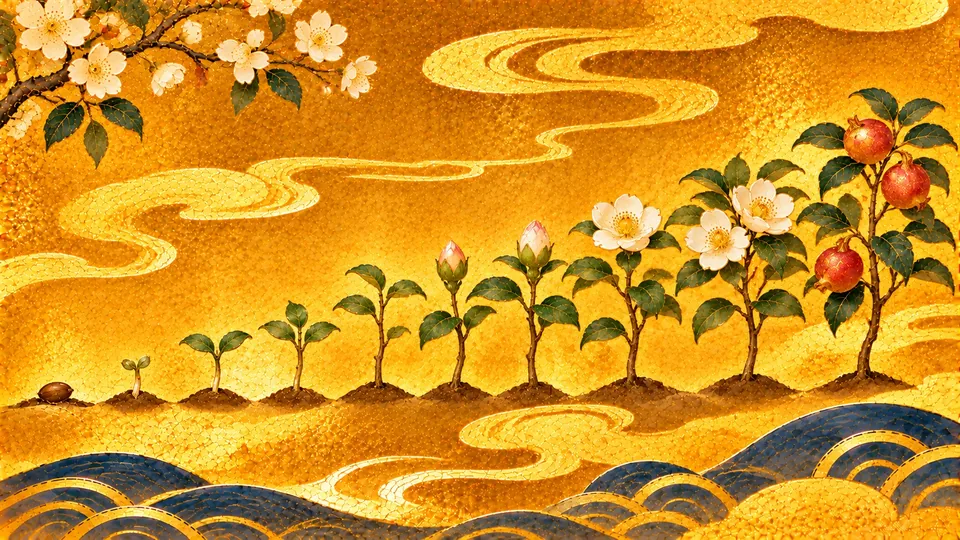
The numbered cards of the Minor Arcana can be read as “the suit’s character × the stage of the number”. Once you learn the flow from Ace to Ten, the meanings of the 40 numbered cards come into view without learning each by heart.
On this page
(Elementary · about 4 minutes to read)
Many modern readers of the Marseille deck read the numbered cards, which show no scenes, by combining the meaning of the number with the nature of the suit. The Waite deck’s pictures are in fact built on this flow of numbers too. From Ace to Ten is the story of one energy sprouting, growing, colliding, bearing fruit and coming to completion. Here are the meanings that most books agree on.
1.The basic meaning of each number
- Ace (1): seed, beginning, pure potential. The suit’s power before it takes form.
- 2: a relationship between two things, balance, choice, partners.
- 3: growth, expression, first results, working together.
- 4: stability, foundations, structure; sometimes being too defensive.
- 5: wobble, conflict, loss, change. The stage where stability breaks and you are tested.
- 6: recovery, harmony, mutual help, giving and receiving.
- 7: assessment, trials, stopping to think, defending your position.
- 8: movement, focus, mastering a skill, a change in circumstances.
- 9: near completion, personal achievement, its strength and its loneliness.
- 10: completion, peak, the end of one cycle and the move to the next.
2.Reading the combinations
Multiply the number by the suit, and the card’s meaning rises naturally. Five, for instance, is the number of wobble. The Five of Wands (fire) is clashing opinions and competition; the Five of Cups (water) emotional loss and regret; the Five of Swords (air) a war of words or a victory that leaves a bad taste; the Five of Pentacles (earth) hardship in money or health. You can see that all share “stability breaking down”.
3.The four Fives
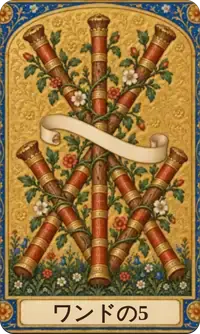
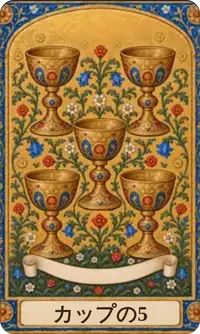
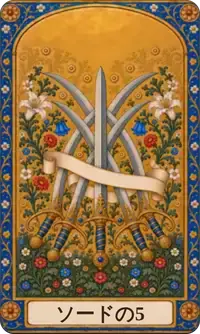
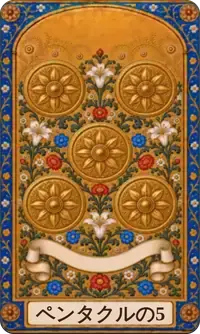
The Fives of Wands, Cups, Swords and Pentacles. The same number, but each suit wobbles differently.
4.Ten is an ending, and also a handover
Ten is the goal of the journey of numbers, but it is also the baton passed to the next Ace. The Ten of Cups is the contented completion of feeling, and the Ten of Pentacles plenty handed down through the generations. The Ten of Wands, though, is the burden of carrying too much passion, and the Ten of Swords the very bottom where thinking ends up. The fire and air Tens look painful in the Waite deck because they show those energies gone too far. Even so, in the Waite Ten of Swords the far sky is beginning to brighten, read as “once you hit bottom, dawn comes”. In this site’s card art, flowers bloom between the ten blades, saying the same thing.
5.The four Tens
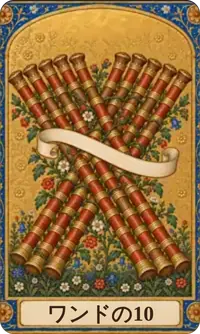
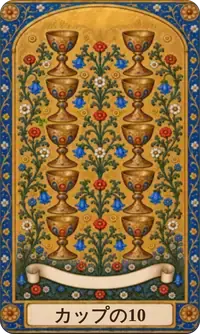
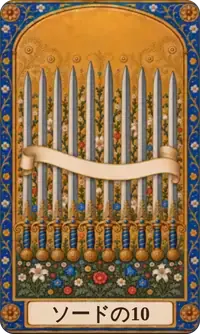
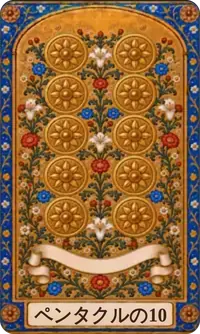
The Tens of Wands, Cups, Swords and Pentacles. What completion looks like differs completely by suit.
6.Reading numbered cards the Marseille way
In the Marseille deck, whose numbered cards have no scenes, the picture itself is “the number” and “the arrangement”. Even numbers are laid out symmetrically, showing balance and stability; odd numbers add one central piece (a single staff among the Wands, a straight sword among the Swords) that breaks the symmetry and shows movement and tension. Just seeing whether the pattern is orderly, or whether something pierces through the middle, tells you the character of the number.
7.Using numbers to see the overall flow
When a spread has many small numbers, things have only just begun and are at the stage of being nurtured. Many middle numbers (4 to 6) mean you are in the middle of adjusting, between stability and change. Many large numbers (8 to 10) mean one theme is entering its final stretch. When the same number appears more than once, its theme is emphasised: three Threes, for example, suggest that cooperation and growth are a big key.
8.A note on memorising
The meanings of the numbers are only a skeleton. In a real reading you flesh them out with the mood of the picture, the question and the surrounding cards. With a sturdy skeleton, you can read even a deck you have never seen. That is one big advantage of learning to read the numbers.
9.A card that seems an exception: the Three of Swords
You have learned “three is the number of growth and expression”, yet the Three of Swords is a card of sorrow. The picture of three swords piercing a heart is from the Waite deck: Smith drew it after the Italian Sola Busca deck of around 1490, and the Golden Dawn named the card “Lord of Sorrow” (in the Marseille deck, two curved blades simply surround one straight sword). This is no contradiction. For the suit of thought and words, air, “the first result to be expressed” is sometimes pain that has been put plainly into words, or a fact you can no longer deny. Seen that way, the Three of Swords can be read as “the stage of putting sorrow into words and beginning to accept it”. When the skeleton of the number seems to clash with the nature of the suit, first ask “what does growth mean for this element?” A common mistake is to put the number first and force an obviously sad picture into a cheerful reading.
10.Practice
Choose one number in the card encyclopedia (Six, say) and look at all four suits’ pictures side by side. Sum up the shared “six-ness” in a word, and note how it differs in each suit.
11.Quiz
Q1. In the flow of numbers, what does Five often stand for?
- Completion and celebration
- Wobble and conflict
- A pure beginning
Answer: Wobble and conflict. Five is the stage where the stability of Four breaks and you are tested, often standing for conflict, loss and change.
Q2. What is the basic meaning of the Ace?
- The end of a cycle
- A clash between two
- The seed and beginning of the suit’s power
Answer: The seed and beginning. The Ace is the number one, pure potential before it takes form.
Q3. How do you read a spread with many numbered cards from 8 to 10?
- Numbers don’t matter
- Things have only just begun
- One theme is entering its final stretch
Answer: One theme is entering its final stretch. Many large numbers are usually read as the second half of a cycle, a time of wrapping up and moving on.
12.Draw a card
Yorozu Goyomi’s tarot reading lets you do a one-card draw, a three-card spread, an either-or reading and the Celtic Cross, free and with no sign-up. Look up the meanings of all 78 cards in the tarot card encyclopedia.
Now try a reading for yourself
Free readings related to this article.
Read next