Spreads and the meaning of positions
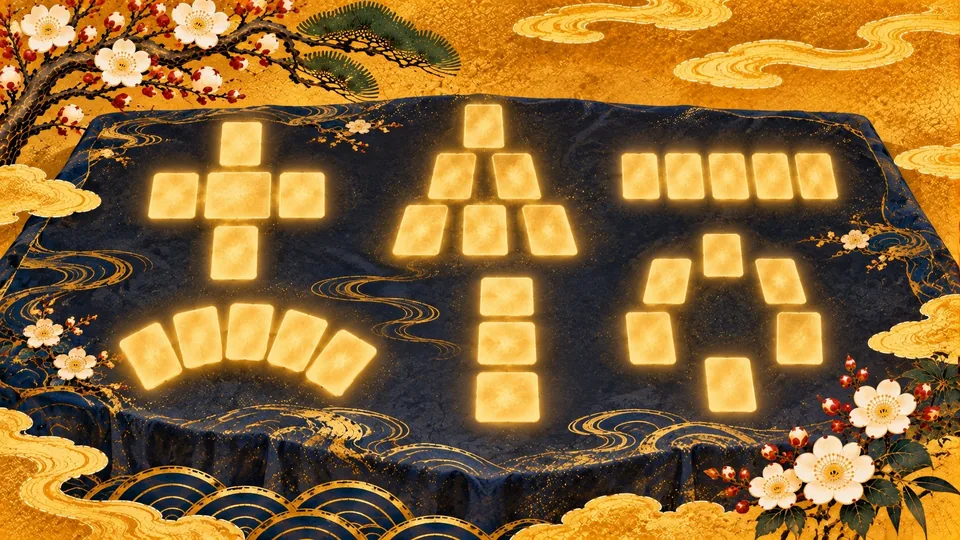
In a spread, the position a card lands in decides “what it is answering”. Let’s learn to use four: the one-card draw, the three-card spread, the either-or spread and the Celtic Cross.
On this page
(Elementary · about 4 minutes to read)
A spread lays the cards out in a set shape and gives each position a meaning. The same card says different things depending on whether it falls in “the past” or “advice”. Think of a position’s meaning as a question that asks the card, “please answer from this angle.”
1.One card: simple and deep
One question, one answer. It suits daily guidance or a word of advice when you are torn. Another plus of the one-card draw is that you set the position’s meaning yourself: change your question to suit, such as “today’s theme”, “what matters most now” or “what I’m overlooking in this matter”.
2.Three cards: grasping the flow
The three-card spread has the widest range of uses. The classic is “past, present, future”, but you can change the meanings of the positions freely. Joan Bunning, too, introduces many three-card combinations.
3.Three-card variations
- Past, present, future: see the flow of events in time.
- Situation, challenge, advice: good for solving problems.
- Me, the other person, the relationship: for questions about relationships.
- Mind, body, spirit: look at your own state.
- Do, don’t, outcome: get guidance for action.
4.An example three-card reading
Say you ask about a work worry with past, present, future, and draw the Eight of Pentacles, the Four of Swords and the Ace of Wands. In the past you worked away steadily; now you are tired from it and need rest; in the future, fresh motivation wells up. So you can read it as “resting properly now is preparation for the next challenge”. The key is to turn the three cards into one continuous story.
5.The example cards
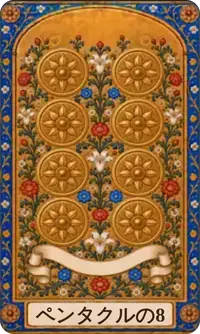
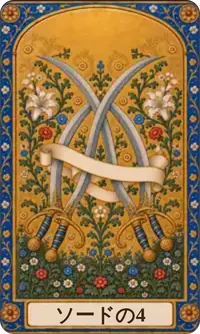
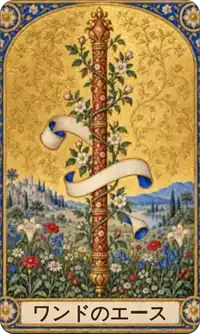
The Eight of Pentacles (past), the Four of Swords (present) and the Ace of Wands (future). The flow of effort, rest and a fresh start is plain to see.
6.Either-or: comparing A and B
Use this when you are torn between two choices. The basic shape is one card in the center for “where you are now”, with one or two cards on the left for “if you choose A” and on the right for “if you choose B”. The point is not to decide which is the “winner” but to learn the nature of each path. Once you see the difference, A is exciting but busy, B calm but with little change, the final choice is yours. On this site, the “outcome” card of each path counts for a little more than the “near future” card.
7.The Celtic Cross: seeing the whole picture
The Celtic Cross is the most famous ten-card spread in the world. Waite first put it into print, as a method already in private use, in The Key to the Tarot (1909–10), the booklet that came with his deck, reprinted in The Pictorial Key to the Tarot (1910). (Its name calls it an “ancient Celtic method”, but there is no evidence of ancient or Celtic origins.) The names of the positions differ a little from book to book, but most guides share these meanings.
8.The ten positions of the Celtic Cross
-
- The present: the theme at the center now
-
- The obstacle (the crossing card): a challenge, or a helping factor
-
- The goal (conscious mind): what you are aware of and aiming for
-
- The foundation (unconscious mind): the true feelings or causes at the root
-
- The past: influences that are passing
-
- The near future: the flow that is coming
-
- Yourself: your attitude and position
-
- Your surroundings: the influence of your environment and the people around you
-
- Hopes and fears: what you wish for, and what you fear
-
- The outcome: the tendency if you carry on as you are
9.Waite’s own names (1910)
In The Pictorial Key to the Tarot (published at the end of 1910, its imprint dated 1911), Waite named the positions from the querent’s point of view: 1 what covers him, 2 what crosses him, 3 what crowns him, 4 what is beneath him, 5 what is behind him, 6 what is before him, 7 himself, 8 his house (surroundings), 9 his hopes or fears, 10 what will come. The modern names above are plainer rewordings of these. Some readers read card 2, the crossing card, as upright whichever way it falls.
10.The significator (the card for the querent)
Waite’s own method begins before the ten cards are laid. First you choose one card to stand for the querent, the significator (often a court card matched to age and coloring, or to temperament), lay it face up and place the first card over it. Most modern readers skip this step and shuffle all 78 cards together. So does this site.
11.Tips for reading the Celtic Cross
Try to read all ten at once and you will get confused. First look at 1 and 2 for the heart of the matter, then 3 and 4 for the gap between conscious and unconscious, 5 and 6 for the flow of time, and 7 to 10 for yourself, your surroundings and where things are heading. Also, card 10, “the outcome”, isn’t a fixed future but the tendency if things go on as they are. If you don’t like the outcome, read it as “changing my attitude (card 7) changes the flow too”.
12.A common mistake
The most common mistakes with spreads are drawing without first setting the positions’ meanings, and changing a position’s meaning afterwards to suit yourself. When a worrying card turns up third, say, you are tempted to reread it: “this isn’t the future, just something to watch for”. But then you are reading your own wishes, not the cards’ voice. Set the positions before you draw, and accept each card in the position it falls in. If a result worries you, drawing one more card for “advice” is a good idea. The next lesson goes into “how to frame a question”, which every spread rests on.
13.Practice
Use the three-card draw on the site, setting the positions as “situation, challenge, advice” before you draw. Your goal is to link the three cards into a one-sentence story.
14.Quiz
Q1. What is the role of a position’s meaning in a spread?
- It changes the card’s picture
- It decides the angle from which the card answers
- It decides the number of cards
Answer: It decides the angle from which the card answers. A position’s meaning is like a question put to the card; the same card says different things in different positions.
Q2. What matters in an either-or spread?
- Learn the nature of each path and choose for yourself
- Redraw until a good card comes up
- Decide which is the winner
Answer: Learn the nature of each path and choose for yourself. The either-or spread is not a verdict but a way of seeing how the options differ. The decision is yours.
Q3. How should the Celtic Cross “outcome” position be read?
- Past events
- A fixed future that can’t change
- The tendency if you carry on as you are
Answer: The tendency if you carry on as you are. The outcome is a tendency, and if your attitude and actions change, the flow changes too.
15.Draw a card
Yorozu Goyomi’s tarot reading lets you do a one-card draw, a three-card spread, an either-or reading and the Celtic Cross, free and with no sign-up. Look up the meanings of all 78 cards in the tarot card encyclopedia.
Now try a reading for yourself
Free readings related to this article.
Read next