Framing a question: good questions and ones to avoid

The quality of a reading is mostly settled before you draw a card. Learn the difference between yes-or-no and open questions, how to ask about timing, and how to ask about other people, with examples of rephrasing.
On this page
(Elementary · about 6 minutes to read)
The same card can give an answer that helps or one that only adds to your worry, depending on how you ask. Tarot is a tool whose view changes with “how you ask”. Lesson 2 touched on the basics of open questions. Here we go a step further and look concretely at the kinds of questions that trip people up, and how to fix them.
1.Why yes-or-no questions are hard
Yes-or-no questions such as “Will he get in touch?” or “Will I pass?” are what you most want to know. But almost every card has both a bright side and a side of challenge, and squeezing it into “yes” or “no” lets what the card is trying to say spill away. The Seven of Wands, for example, is a card of standing your ground in spite of struggle. Whether it reads as “yes” or “no” tends to depend on the reader’s mood.
2.Rephrase as an open question
So keep the wish to know, but change the shape of the question to “how”, “what” or “what kind”. “Will I pass?” becomes “What should I put most effort into now to get closer to passing?” Then whatever card comes up, you can read it as an answer that leads to action. You don’t have to deny wanting to know the result; just ask about the path towards it.
3.If you still want a yes or no
If you really want a two-way answer, one method is to set a rule before you draw, such as “upright means a tailwind, reversed means there are challenges”. But that answer is a tendency, not a certainty. Even with a tailwind card you need to prepare, and a challenge card is telling you what to put right. It also matters not to make a big decision on the result of one card.
4.Tips for asking about timing
Questions of timing, like “When will I marry?” or “When can I change jobs?”, are an area where tarot is especially weak. There are traditions that map suits to seasons and numbers to days or weeks, but they vary from school to school and there is no fixed answer. This site first shows each card’s own pace, and adds the Golden Dawn’s dates for the numbered cards and the Knights, Queens and Kings as a second guide (see the last lesson). What we recommend is to set the time frame yourself. Ask “What should I keep in mind about work over the next three months?” or “What should I prepare by next month?”, and the cards will tell you how to spend that time.
5.Asking about other people
“What does that person think of me?” is one of the most common questions in love. Caring about someone is natural, and asking now and then is fine. But cards can’t pin down another person’s heart, and many readers avoid questions that pry into someone’s secrets when they aren’t there. We recommend bringing the subject back to yourself. Ask “What should I value in my relationship with that person?”, and the answer reaches what you can actually change.
6.Things best not asked of the cards
- Diagnosing illness or deciding on treatment: talk to a doctor about your body. The cards can help you sort out anxious feelings.
- Legal decisions such as court cases and contracts: expert advice comes first.
- Whether an investment or bet will win: the cards don’t guarantee money results. Turn it into a question about how you deal with money.
- Questions trying to find out someone’s lifespan or misfortune: they only grow anxiety and help no one.
- Matters of your safety, such as violence or sexual harm: before the cards, go to someone you trust or a support service.
7.Examples of rephrasing
- “Will he get in touch?” → “What can I do to let my relationship with him move along comfortably?”
- “Will this job succeed?” → “What should I put effort into now to bring this job closer to success?”
- “Which is right, A or B?” → “What kind of flow is each likely to bring, if I choose A or if I choose B?”
- “When will I find a partner?” → “What should I keep in mind over the next six months as I look to meet someone?”
- “Why does nothing ever go right for me?” → “What can I learn from my situation now?”
- “Does that person dislike me?” → “What should I be careful about in my relationship with that person?”
- “Will I get rich?” → “What is the key to dealing well with money this year?”
- “What will happen with my job change and my marriage?” → Split it in two and ask one at a time.
8.Checklist for a good question
- Is “I” the subject?
- Is it narrowed to one theme?
- If a time frame is needed, have you set one (today, this month, the next three months)?
- Is it shaped so you can do something once you hear the answer?
- Are you asking out of wanting to know, not out of fear or haste?
9.Pairing questions with spreads
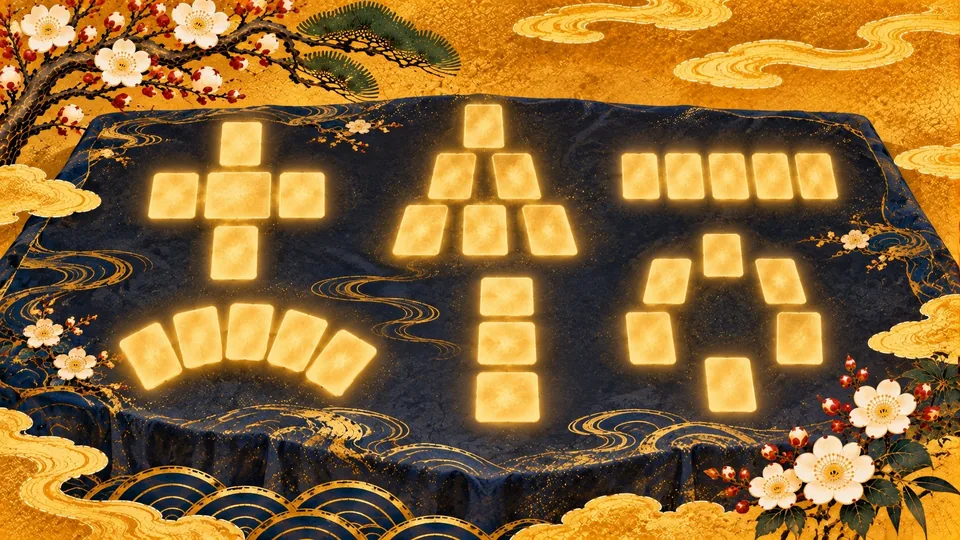
Once the question is set, choose a layout to match. For how to spend today, a one-card draw; to see the flow, a past-present-future three-card spread; if you are torn between choices, the either-or spread. On this site, the words you type in the question box stay on the results screen too. Write something short but specific, so that when you look back at your records you can see “what I wanted to know then”.
10.A little preparation before you ask
When a question won’t come together, before you draw, try listing three things that are on your mind. Then ask yourself, “Which of these would lighten my heart most if I knew the answer?” The one you choose is today’s question. Next, think, “If I knew that, what would I do?” A question with no answer to that may be one that won’t lead to action even if you know. Finally, take a breath, then say the question out loud or type it in the box. These few dozen seconds of preparation make a big difference to how satisfied you feel after the reading.
11.A common mistake
The most common is cramming several themes into one question. Ask “What will happen with work and love?”, and you can’t tell which one a card is about. The next most common is redrawing the same question until you get the answer you want. When you can’t accept an answer, asking “what is this card showing me that I don’t want to see?” teaches far more than drawing again.
12.Practice
First write what is on your mind now in one sentence, just as it comes. Then use the checklist above to rewrite it as a question with the subject, theme, time frame and action all set. Do a three-card draw with the rewritten question, and compare how you would have felt with the original.
13.Quiz
Q1. Make “Will I pass?” into a question that suits tarot.
- Tell me clearly whether I’ll pass
- What should I put most effort into now to get closer to passing?
- Tell me every reason I won’t pass
Answer: What should I put most effort into now to get closer to passing? Keeping the wish to know the result but asking about the path to it lets you read an answer that leads to action from any card.
Q2. What is a sensible approach to timing questions?
- Set the time frame yourself and ask how to spend it
- A card’s number is the number of days
- Never ask about timing
Answer: Set the time frame yourself. Timing systems differ between schools and have no fixed answer; asking within a set period gives a more useful reply.
Q3. How might you rephrase “What does that person think of me?”
- Tell me all that person’s secrets
- Will that person contact me tonight?
- What should I value in my relationship with that person?
Answer: What should I value in my relationship with that person? Bringing the subject back to yourself makes the answer reach what you can change, and avoids deciding what another person feels.
14.Draw a card
Yorozu Goyomi’s tarot reading lets you do a one-card draw, a three-card spread, an either-or reading and the Celtic Cross, free and with no sign-up. Look up the meanings of all 78 cards in the tarot card encyclopedia.
Now try a reading for yourself
Free readings related to this article.
Read next