Reading combinations: story and elemental dignities
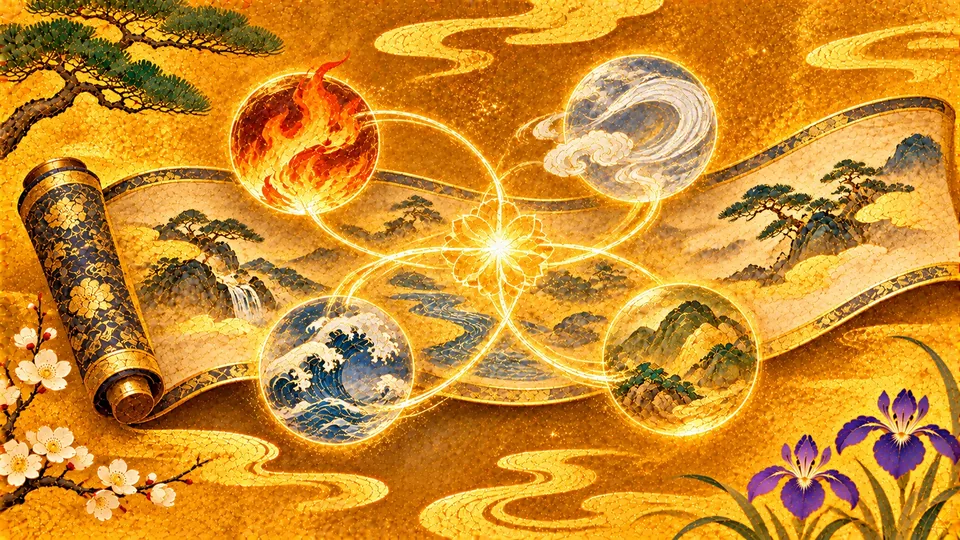
Looking up cards one at a time in a dictionary won’t bring a reading to life. Here you’ll learn how to link several cards into a story, and the basics of elemental dignities, which read cards through how their elements get along.
On this page
(Intermediate · about 4 minutes to read)
A common beginner’s reading goes: “The first card means this, the second means that, the third means something else.” The meanings are listed and that’s the end. A skilled reader looks at how the cards relate to each other and tells them as a single story. This lesson gives you concrete steps for doing that.
1.Step 1: Take in the whole spread
Before reading any single card, look over the whole spread for a few seconds. Are there many Major Arcana? Which suit dominates? Are the numbers low or high? Are many cards reversed? Which way are the figures facing? This overall impression sets the “tone” of the story. If the spread is bright in colour, the story is likely a hopeful one. If it is full of Swords and heavy in colour, it may be a story of getting stuck by overthinking.
2.Step 2: Use linking words
Try reading with words such as “so”, “but”, “and then” or “as a result” between the cards. Lay out “Two of Cups, but the Tower, and as a result the Star”, and a story appears: “A relationship where hearts meet begins. But an unexpected event breaks its present shape. As a result, a hope closer to your true self comes into view.”
3.Turning it into a story
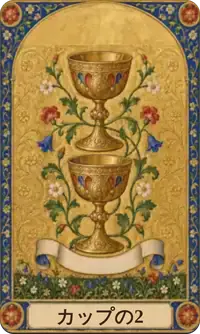
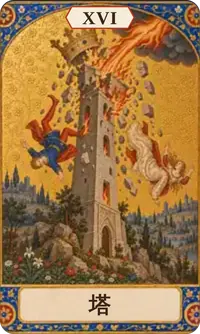
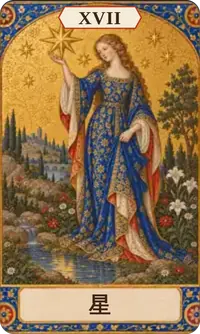
The Two of Cups, the Tower and the Star: meeting, upheaval, then hope. Just adding linking words turns three cards into one flow.
4.Step 3: Cards that reinforce or cancel out
When cards with similar meanings sit side by side, that theme is emphasised. The Eight of Wands next to the Chariot says “things are about to move fast”. When cards with opposite meanings appear together, they show an inner conflict or a situation with two sides. The Emperor with the Page of Cups can be read as a tug of war between “the part of you that wants to do things properly” and “the part that wants to be looked after”.
5.What are elemental dignities?
Elemental dignities come from the Hermetic Order of the Golden Dawn. The idea is that a card grows stronger or weaker depending on how its element gets along with the elements of the cards beside it. Readers who don’t use reversals often rely on this method to judge how strongly a card speaks.
6.How the elements get along (the basics)
- The same element: they strengthen each other (Wands with Wands, for example).
- Friendly: fire with air, water with earth. They work together and raise each other’s power.
- Hostile: fire with water, air with earth. They weaken each other and create tension.
- Mildly friendly: fire with earth, water with air. The Golden Dawn’s Book T counts these pairs as friendly too. (Some modern books call them “neutral”, but that is a simplification.) They are not as strong as fire with air or water with earth, but they quietly support each other.
7.Elements of the Major Arcana
The Major Arcana are given elements too, through their astrological correspondences. The Emperor is Aries and so fire, the Lovers are Gemini and so air, Death is Scorpio and so water, and the Devil is Capricorn and so earth. At first, judge by the Minor Arcana suits only. Once you are used to it, extend the method to the Major Arcana using the correspondences listed in the card encyclopedia.
8.A worked example
Say a three-card spread has the Six of Cups (water) in the middle, with the Seven of Wands (fire) on the left and the Three of Swords (air) on the right. For water, fire is hostile and air is mildly friendly. So the Six of Cups’ “nostalgia and gentle memories” struggle to show themselves because of the fire beside them, and get only a little help from the air on the other side. The reading might be: “You remember a warm relationship from the past, but right now you are so busy protecting yourself that you find it hard to let that feeling show.”
9.An example of elemental dignities
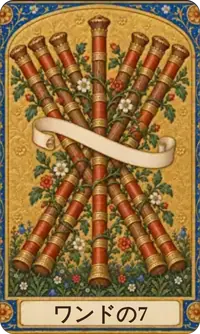
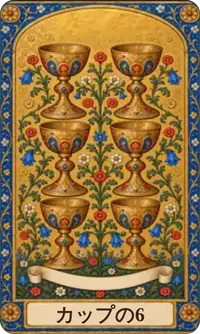
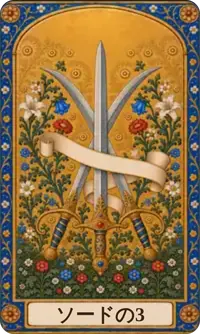
The Seven of Wands (fire), the Six of Cups (water) and the Three of Swords (air). The water in the middle is weakened by the fire next to it.
10.The quintessence (theme card)
Add up the numbers of every card in the spread. Aces count as 1, court cards as 0, and the Major Arcana as their own numbers (the Fool is 0, the World is 21). If the total is more than 22, add its digits together until it is 22 or less, and read the Major Arcana card with that number as the theme running underneath the whole reading. A total of exactly 22 is the Fool. For example, 77 becomes 7 + 7 = 14, Temperance. This site picks its theme card the same way. The numbers follow the Waite deck. In the Marseille deck, 8 is Justice and 11 is Strength, so a total of 8 or 11 points to the other card.
11.A word on reading combinations
Elemental dignities are a handy tool, but you don’t have to apply them mechanically to everything. Check them against the impression the pictures give you and against the question, and take in the parts that feel right. Reading combinations improves with experience. If it doesn’t go well at first, that is perfectly natural.
12.Reading two cards that seem to contradict
Suppose a work question brings the Sun next to the Ten of Swords. The Sun is success and brightness; the Ten of Swords is an ending and rock bottom. At first glance they are opposites. Instead of ignoring one of them, look for a story in which both are true at once. For example: “One way of doing things comes clearly to an end, and that actually leaves you feeling lighter.” Or, if they sit in the past and future positions: “Once you are through the worst, a bright result is waiting.” The more contradictory a combination looks, the more honestly it often reflects how complicated the situation is. A common mistake is to read only the card you like.
Next lesson: “A worked reading: a three-card spread from start to finish”
13.Practice
Do a three-card draw on the site and first make a one-sentence story using linking words. Then check how the middle card’s element gets along with the cards on either side, decide whether the middle card is strengthened or weakened, and rewrite your story.
14.Quick quiz
Q1. In elemental dignities, which pair is “hostile”?
- Fire and air
- Fire and water
- Water and earth
Answer: Fire and water. Fire with water and air with earth are hostile and weaken each other. Fire with air and water with earth are friendly.
Q2. Which method helps you link cards into a story?
- Putting linking words between the cards
- Reading only the first card
- Listing each card’s meaning as bullet points
Answer: Putting linking words between the cards. Words like “so” and “but” reveal how the cards relate and make the story flow naturally.
Q3. When cards with similar meanings appear together, how is that usually read?
- Ignore one of them
- The theme is emphasised
- The meanings cancel out
Answer: The theme is emphasised. When similar meanings overlap, the usual reading is that the theme is coming through strongly.
15.Draw a card
Yorozu Goyomi’s tarot reading lets you do a one-card draw, a three-card spread, an either-or reading and the Celtic Cross, free and with no sign-up. Look up the meanings of all 78 cards in the tarot card encyclopedia.
Now try a reading for yourself
Free readings related to this article.
Read next