What is tenchūsatsu (kūbō)?
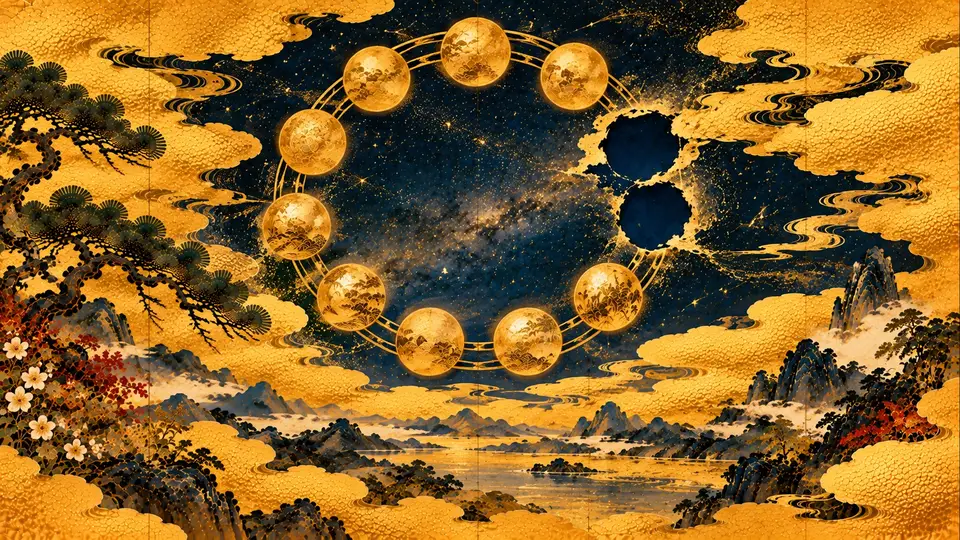
There are 10 stems and 12 branches. As you pair them up, every time the stems go round once in 10 pairs, two branches are left over. These “two branches with no heavenly stem” are kūbō, “emptiness”, and in Sanmeigaku they are called tenchūsatsu.
On this page
1.The six groups of kūbō
The sixty eto are divided into six decades (jun) of ten, each starting with Kinoe (甲). The two branches left over in each decade are its kūbō.
| Decade | Day eto it contains | Void branches |
|---|---|---|
| Kinoe-ne decade | 甲子 to 癸酉 | Dog–Pig |
| Kinoe-inu decade | 甲戌 to 癸未 | Monkey–Rooster |
| Kinoe-saru decade | 甲申 to 癸巳 | Horse–Goat |
| Kinoe-uma decade | 甲午 to 癸卯 | Dragon–Snake |
| Kinoe-tatsu decade | 甲辰 to 癸丑 | Tiger–Rabbit |
| Kinoe-tora decade | 甲寅 to 癸亥 | Rat–Ox |
2.The six kinds of tenchūsatsu and their tendencies
Sanmeigaku holds that each void group comes with inborn tendencies. These are examples of common interpretations; the reading changes with the whole chart.
- Rat–Ox void: missing the two northern branches, the start of a family line, so said to open your own way without relying on parents or superiors. This type is called “first-generation luck”: founding a household by your own effort.
- Tiger–Rabbit void: the type missing the two eastern branches, budding and growth, called “successor luck (home)”. Its role is to inherit and protect, and its theme is to value your home and the foundations close to you.
- Dragon–Snake void: the type called “off-the-track luck (practical)”, said to be a type that easily strays from the family line, with unconventional ideas and the strength to live through a life of ups and downs.
- Horse–Goat void: the type missing the two southern branches, youth and momentum, called “last-generation luck (the one who pulls things together)”. Its theme is to sort out what has built up, bring it together and hand it on.
- Monkey–Rooster void: the type missing the two western branches, harvest and reality, called “successor luck (work)”. Its theme is to take over work and roles, protect them and expand them.
- Dog–Pig void: the type called “off-the-track luck (spiritual)”. Missing the two northwestern branches, which stand for the world of the spirit, so said, on the contrary, to seek spirituality and ideals strongly and to have a world view all your own.
3.What kūbō means
Kūbō years (two in every twelve) and months are said to be times when heaven’s help is hard to get, so big decisions and new starts are approached with care. On the other hand, they are also good times to look at yourself again and polish your inner self.
There is no need to be too afraid. Use kūbō as “a sign telling you when to rest”.
4.Void years (chart from 2026)
The two years whose animal matches your two void branches are your “void years”. They come once every twelve years, two years in a row. The year changes at Risshun (around February 4).
| Year (from Risshun) | Year’s eto | Void year for |
|---|---|---|
| 2026 | 丙午 Hinoe-uma | People whose void is Horse–Goat |
| 2027 | 丁未 Hinoto-hitsuji | People whose void is Horse–Goat |
| 2028 | 戊申 Tsuchinoe-saru | People whose void is Monkey–Rooster |
| 2029 | 己酉 Tsuchinoto-tori | People whose void is Monkey–Rooster |
| 2030 | 庚戌 Kanoe-inu | People whose void is Dog–Pig |
| 2031 | 辛亥 Kanoto-i | People whose void is Dog–Pig |
| 2032 | 壬子 Mizunoe-ne | People whose void is Rat–Ox |
| 2033 | 癸丑 Mizunoto-ushi | People whose void is Rat–Ox |
| 2034 | 甲寅 Kinoe-tora | People whose void is Tiger–Rabbit |
| 2035 | 乙卯 Kinoto-u | People whose void is Tiger–Rabbit |
| 2036 | 丙辰 Hinoe-tatsu | People whose void is Dragon–Snake |
| 2037 | 丁巳 Hinoto-mi | People whose void is Dragon–Snake |
Your void (tenchūsatsu) is the pair of branches set by the eto of your birth day. Your void years are the two years whose animal matches that pair.
2026 (Hinoe-uma) and 2027 (Hinoto-hitsuji) are the two void years for people with a Horse–Goat void. Sanmeigaku advises avoiding starting big decisions of your own, such as marriage, a job change, going independent or buying a home, during this time, and carefully continuing what you already have.
5.Void months
There are void months too: the two months whose branch matches your void branches, at the same time every year. The month changes at the start of each solar month (Risshun, Keichitsu and so on).
| Void | Void months (approximate) |
|---|---|
| Rat–Ox | Around Dec 7 to around Feb 3 |
| Tiger–Rabbit | Around Feb 4 to around Apr 4 |
| Dragon–Snake | Around Apr 5 to around Jun 5 |
| Horse–Goat | Around Jun 6 to around Aug 6 |
| Monkey–Rooster | Around Aug 7 to around Oct 7 |
| Dog–Pig | Around Oct 8 to around Dec 6 |
6.Common questions about tenchūsatsu
Can I get married during a void? Sanmeigaku holds that what you start yourself during a void tends not to go as planned, and many people avoid it for registering a marriage or holding a wedding. But marrying someone you were already with before the void counts as “continuing what you have”, and some say there is no need to worry too much.
What about changing jobs or moving house? The usual advice is to go easy on changing your surroundings by your own choice. Changes you didn’t choose, such as a transfer ordered by your company or a move you can’t avoid, are not counted. If dates and directions are on your mind too, see good days for moving and Nine Star Ki lucky directions.
Does only bad happen during a void? No. Because heaven’s help is hard to come by, it is a time when your own ability is tested. It suits putting your inner life in order: studying, earning a qualification, looking at your health, sorting out relationships.
Practical advice for each period is in How to spend a void period, and the year ahead in 2027 in Sanmeigaku.
7.Find your own kūbō
Your kūbō is set by the eto of your day of birth (your day pillar). Enter your date of birth in the birth chart reading (Japanese), and it is shown automatically.
Now try a reading for yourself
Free readings related to this article.
Read next