What is Four Pillars of Destiny (shichū suimei)?
Four Pillars of Destiny (shichū suimei) reads a person’s nature and the flow of their fate from four eto, the four pillars of the year, month, day and hour of birth. In China it is also called bazi, “eight characters”. It comes from the Ziping method, in which Xu Ziping in the early Song dynasty reworked Li Xuzhong’s Tang-dynasty method of year, month and day so that it centered on the day stem. It was introduced to Japan in the late Edo period, and “shichū suimei” is its Japanese name.
On this page
1.What is the chart?
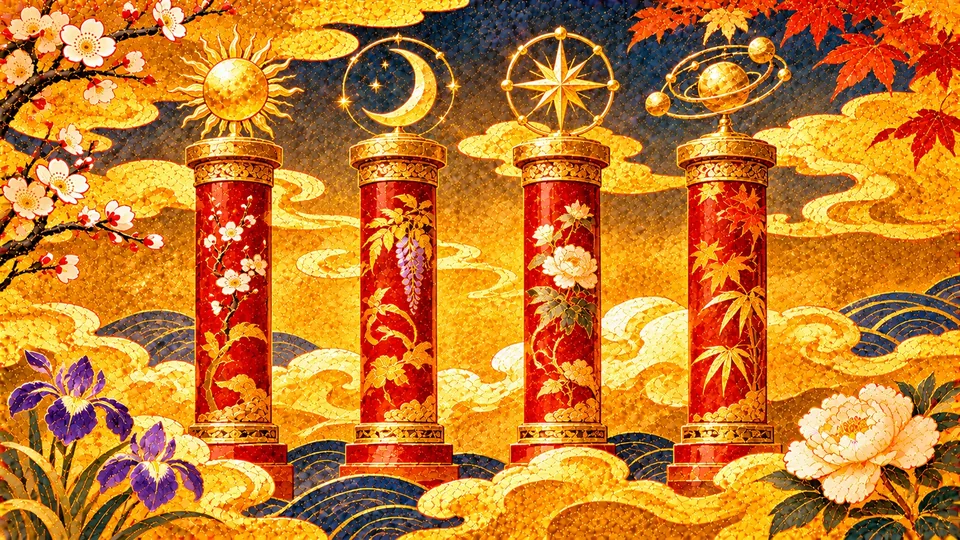
The four pillars set out as a table are called the chart (meishiki). The year pillar is said to show ancestors and childhood, the month pillar parents, youth and your fortune in society, the day pillar yourself and your spouse, and the hour pillar your children and later life.
2.The most important: the day stem
Four Pillars treats the heavenly stem of your day of birth, the day stem, as “you”. A Kinoe (甲) day stem, for example, is read as someone like a tall straight tree, and a Hinoe (丙) day stem as someone like the sun. Find your day stem with the birth chart reading (Japanese), and read about each character on the ten stems.
3.The ten gods (tsūhensei)
The ten gods are ten stars that express the element relationship between your day stem and each other stem (including the hidden stems in the branches).
| Relationship | Same yin/yang | Different yin/yang | Meaning |
|---|---|---|---|
| Same element | Hiken | Gōzai | Independence, companions, rivalry |
| Produced by the day stem | Shokujin | Shōkan | Expression, talent, enjoyment |
| Controlled by the day stem | Henzai | Seizai | Wealth, connections, father |
| Controls the day stem | Henkan | Seikan | Work, responsibility, status |
| Produces the day stem | Hen’in | Injū | Wisdom, learning, mother |
4.The twelve stages (jūniun)
The twelve stages show how much momentum your day stem has on each branch, in twelve steps compared to a human life.
Chōsei · Mokuyoku · Kantai · Kenroku · Teiō · Sui · Byō · Shi · Bo · Zetsu · Tai · Yō
Names such as Shi (“death”) and Bo (“grave”) sound ominous, but they are not bad. Bo is read as a storehouse that keeps wealth and knowledge, for instance, and Shi as the power to master things quietly.
5.Hidden stems (zōkan)
Each of the twelve branches is thought to hold stems hidden inside it, called hidden stems. The Rat (子) contains 癸, for example, and the Horse (午) contains 丁. This site’s birth chart reading uses each branch’s representative hidden stem (its main qi) to find the ten gods.
Four Pillars has deeper theory still, such as chart structures and the useful god. As well as the basic chart, this site’s birth chart reading also shows your ten-year luck periods and the flow of each year. For a serious judgment, have a professional reading.
6.Go deeper
Now try a reading for yourself
Free readings related to this article.
Read next