Strong and weak day stems (mikyō and mijaku) in Four Pillars of Destiny
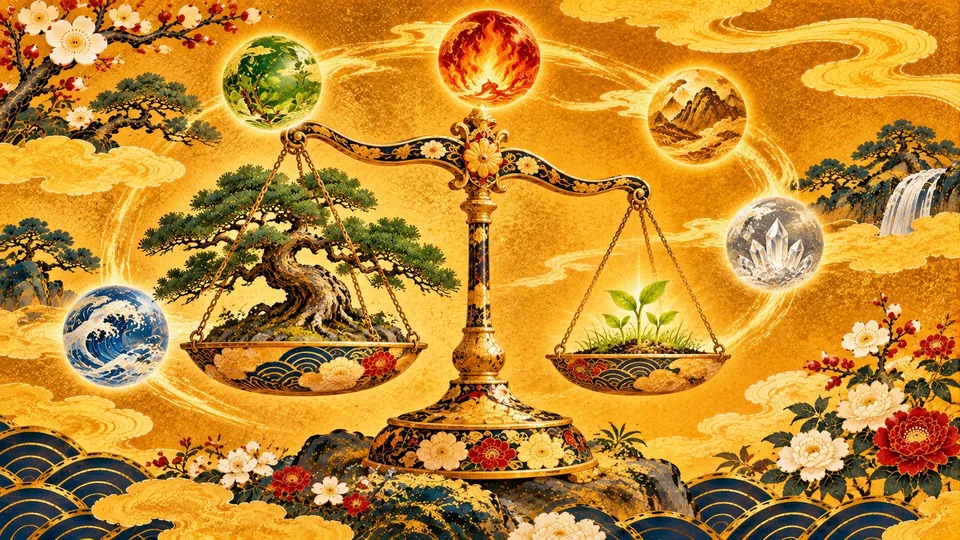
In Four Pillars of Destiny, you look at the eight characters of a chart and ask whether there is more that supports your day stem (you) or more that weakens and drains it. If the supporting side wins, the chart is mikyō, “strong self”; if it loses, mijaku, “weak self”.
On this page
1.How to judge it
Two things support the day stem:
- The same element as the day stem (Hiken and Gōzai)
- The element that produces the day stem (Hen’in and Injū)
On the other side, the element the day stem produces (Shokujin and Shōkan), the element it controls (Henzai and Seizai) and the element that controls it (Henkan and Seikan) all weaken it.
The biggest single influence is the branch of your birth month. If the month branch is the season of your day stem’s element (a Wood day stem born in spring, for example), the day stem easily gains strength. You then add in the elements of the stems and branches of the other pillars.
The exact standards differ between schools and readers, and the same chart can be judged strong by one and weak by another.
2.Tendencies of strong and weak charts
| Strong (mikyō) | Weak (mijaku) | |
|---|---|---|
| Strengths | Opens your own path; assertive | Flexible with others; cooperative |
| Watch out for | Can become stubborn | Takes on too much and wears out |
| Shines when | Trusted to act on your own | Teaming up with people you trust |
Strong is not good and weak is not bad. They are just different ways of using your power.
3.The useful god (yōjin)
The element that corrects the bias of a chart and improves its balance is called the useful god (yōjin).
- For a strong chart: elements that let power flow out (Shokujin and Shōkan, wealth, authority) tend to be the useful god.
- For a weak chart: elements that support the day stem (Hiken and Gōzai, the resource stars) tend to be the useful god.
The idea is that bringing the useful god’s element into your colors, directions, work and surroundings makes life easier. Some schools put “climate adjustment” (chōkō), balancing the heat and cold of the season, first, and choosing the useful god is one of the areas where schools of Four Pillars differ most.
4.If you don’t know your birth time
Even without the hour pillar, the year, month and day pillars show most of the picture: the day stem, the month branch and the balance of the elements. How much the hour pillar affects strength depends on the chart, so if yours is close to the line, it is safest to remember that the judgment could change with the time of birth.
Sanmeigaku is a method that has always used just three pillars, year, month and day, without the hour. The differences are explained in Sanmeigaku and Four Pillars compared.
5.Check your own chart
The birth chart reading (Japanese) shows your day stem and a graph of your balance of elements, so you can see at a glance which elements you have most of. For the nature of each element, see the five elements.
Now try a reading for yourself
Free readings related to this article.
Read next