Inborn tenchūsatsu (shukumei tenchūsatsu)
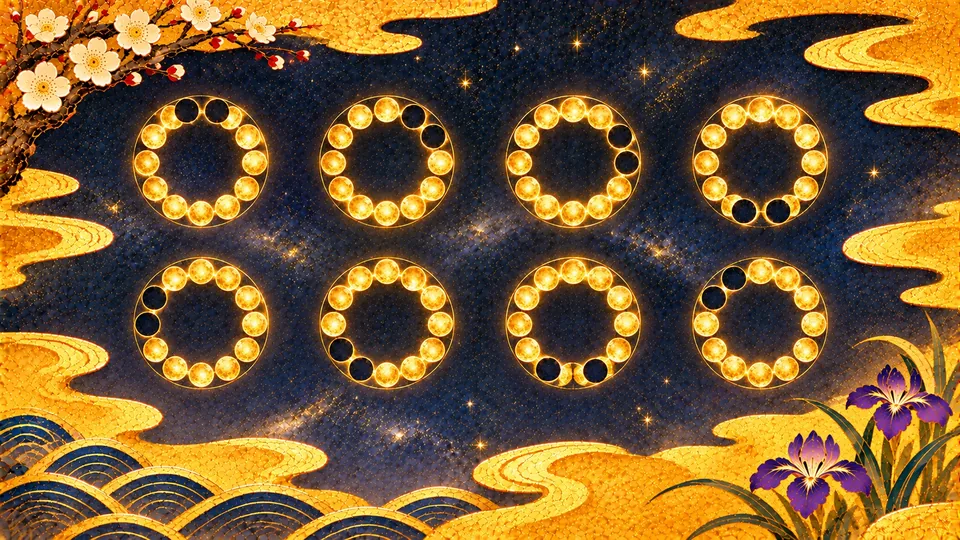
Tenchūsatsu is usually talked about as “two years that come round every twelve”. Separately from that, the eto of your year, month or day of birth may itself contain one of your void branches. This is called shukumei tenchūsatsu, inborn tenchūsatsu.
On this page
1.The eight kinds
| Name | Condition |
|---|---|
| Seinen-chūsatsu (birth year) | The year branch is one of the two void branches set by the day pillar |
| Seigetsu-chūsatsu (birth month) | The month branch is one of the two void branches set by the day pillar |
| Seijitsu-chūsatsu (birth day) | The day branch is one of the two void branches set by the year pillar |
| Nichiza-chūsatsu | The day pillar is 甲戌 (Kinoe-inu) or 乙亥 (Kinoto-i) |
| Nikkyo-chūsatsu | The day pillar is 甲辰 (Kinoe-tatsu) or 乙巳 (Kinoto-mi) |
| Gokan-chūsatsu | Both Seinen and Seijitsu |
| Shukumei Ni-chūsatsu | Both Seinen and Seigetsu |
| Zen-tenchūsatsu (complete) | All three: Seinen, Seigetsu and Nichiza |
2.How to read it
Inborn tenchūsatsu is said to make matters tied to its position (year = parents and superiors, month = your inner self and work, day = home and spouse) come out in ways that don’t fit the usual mold. It is generally read not as a bad sign but as a personality that does its best work outside the frame.
3.Voids between two people
Some kinds, such as mutual or shared voids, only arise when two people’s charts are compared. They cannot be judged from one person’s chart.
4.See your own inborn tenchūsatsu
In the “tenchūsatsu” section of the Sanmeigaku reading (Japanese), you can check whether each of the eight kinds applies to you, and the condition behind it.
Now try a reading for yourself
Free readings related to this article.
Read next