The phase method (isōhō) of Sanmeigaku
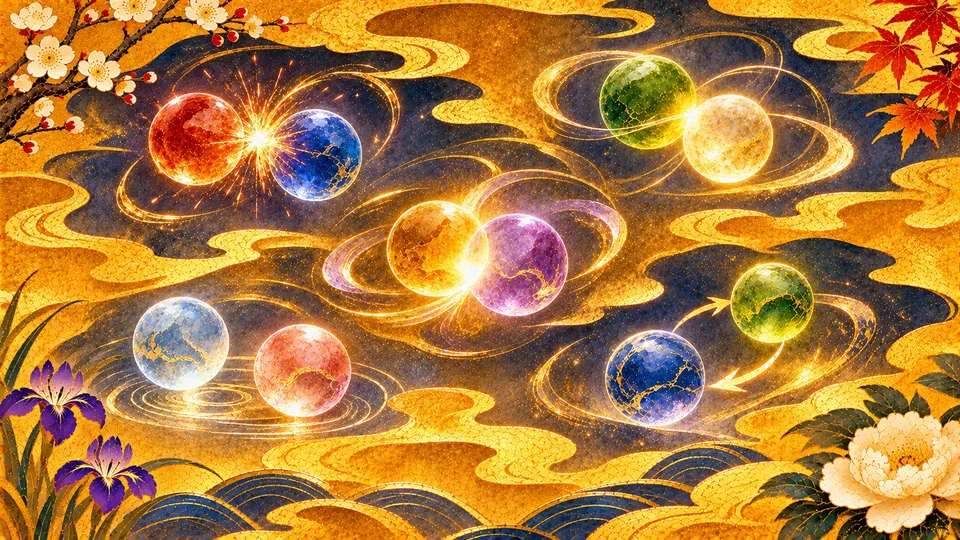
The phase method (isōhō) compares two eto and reads their relationship by giving it a name. It is used to compare the pillars of a chart with each other (your destiny), or your chart with the eto of a ten-year or yearly period (your fortune).
On this page
1.What is compared
The eto of a period is compared with each of the three pillars of your chart. Sanmeigaku also gives each pillar a direction:
| Pillar | Direction | Mainly shows |
|---|---|---|
| Day | West | You, your home, your spouse |
| Month | Center | Your inner self, your workplace |
| Year | East | Parents, superiors, ancestors |
2.The main relationships
| Name | What it is |
|---|---|
| Ritchin (律音) | Exactly the same eto |
| Nacchin (納音) | The same stem, with branches facing each other (a clash) |
| Tenkoku-chichū (天剋地冲) | The stems control each other and the branches clash |
| Daihankai (大半会) | The branches form a half union and the stems are the same |
| Kangō, stem combination (干合) | 甲 with 己, 乙 with 庚, 丙 with 辛, 丁 with 壬, 戊 with 癸 |
| Shigō, branch union (支合) | Rat–Ox, Tiger–Pig, Rabbit–Dog, Dragon–Rooster, Snake–Monkey, Horse–Goat |
| Hankai, half union (半会) | Two of the three branches of a triple union (Monkey–Rat, Rat–Dragon, Pig–Rabbit, Rabbit–Goat and so on) |
| Taichū, clash (対冲) | Branches facing each other (Rat–Horse, Ox–Goat and so on) |
| Kei, punishment (刑) | Four kinds: Seiki-kei, Koki-kei, Ōki-kei and self-punishment |
| Gai, harm (害) | Rat–Goat, Ox–Horse, Tiger–Snake, Rabbit–Dragon, Monkey–Pig, Rooster–Dog |
| Ha, break (破) | Rat–Rooster, Ox–Dragon, Tiger–Pig, Rabbit–Horse, Snake–Monkey, Goat–Dog |
Combinations and unions (kangō, shigō, hankai) are relationships that join and bind, while clashes, punishments, harms and breaks are relationships that move and collide. A colliding relationship is not necessarily bad, though; it can also be read as a trigger for change and action.
3.Not the classical “nacchin”
In the phase method, nacchin means “the same stem with clashing branches”. It is a different thing from the classical nacchin (nayin), which gives each of the sixty eto a name such as “metal in the sea” or “fire in the furnace”.
4.Relationships of three branches
Some relationships, such as the triple union and the directional triad, only form when three branches come together. A table comparing two eto usually leaves them out.
5.See your own phase relationships
The Sanmeigaku reading (Japanese) lists the relationships between the pillars of your chart (your destiny’s phases), and between the eto of each ten-year and yearly period and your day, month and year pillars. For relationships between the twelve animals, see also the twelve animals.
Now try a reading for yourself
Free readings related to this article.
Read next