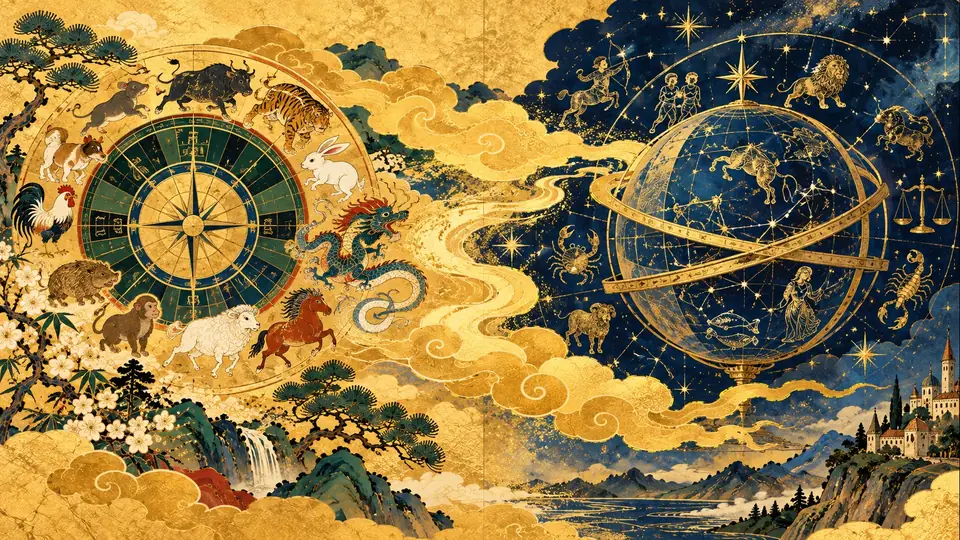
The twelve branches (jūnishi)
By the Shang dynasty, the twelve branches were already being paired with the ten stems to record dates. Later they were linked to Jupiter, which takes about 12 years to circle the sky, and began to be used for counting years too. (In practice, years were counted by an imaginary body, Taisui, that moves the opposite way to Jupiter.)
On this page
1.The order and names
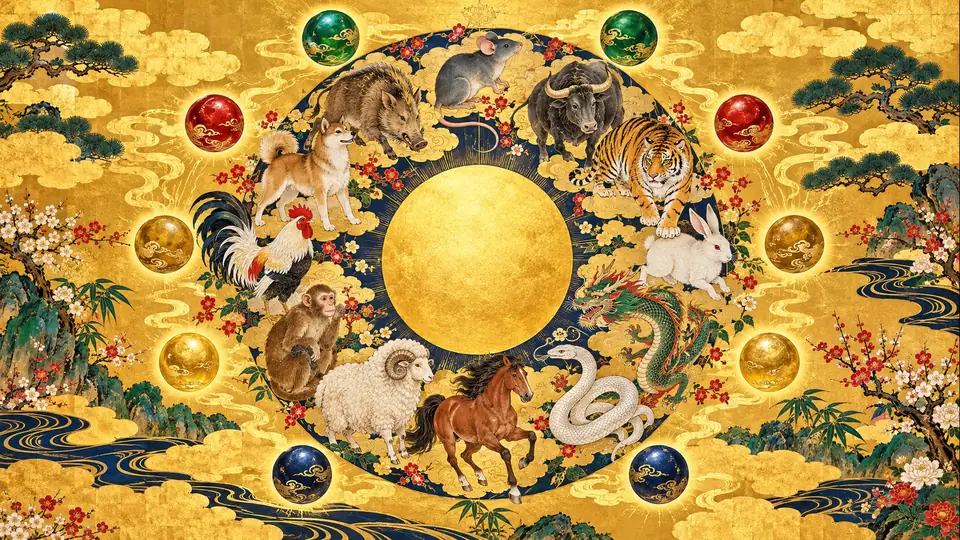
| # | Branch | Reading | Animal | Element | Direction | Hours |
|---|---|---|---|---|---|---|
| 1 | 子 | Ne | Rat | Water | North | 11 pm – 1 am |
| 2 | 丑 | Ushi | Ox | Earth | North-northeast | 1 am – 3 am |
| 3 | 寅 | Tora | Tiger | Wood | East-northeast | 3 am – 5 am |
| 4 | 卯 | U | Rabbit | Wood | East | 5 am – 7 am |
| 5 | 辰 | Tatsu | Dragon | Earth | East-southeast | 7 am – 9 am |
| 6 | 巳 | Mi | Snake | Fire | South-southeast | 9 am – 11 am |
| 7 | 午 | Uma | Horse | Fire | South | 11 am – 1 pm |
| 8 | 未 | Hitsuji | Goat | Earth | South-southwest | 1 pm – 3 pm |
| 9 | 申 | Saru | Monkey | Metal | West-southwest | 3 pm – 5 pm |
| 10 | 酉 | Tori | Rooster | Metal | West | 5 pm – 7 pm |
| 11 | 戌 | Inu | Dog | Earth | West-northwest | 7 pm – 9 pm |
| 12 | 亥 | I | Pig | Water | North-northwest | 9 pm – 11 pm |
Japanese children learn the order as a chant: ne, ushi, tora, u, tatsu, mi, uma, hitsuji, saru, tori, inu, i. Saying it out loud with a rhythm is still the easiest way.
2.The animals came later
The twelve characters did not originally mean animals. Their first meanings are uncertain, but Han-dynasty writers explained them through words that sound alike: the Book of Han glosses 子 as “to multiply” and 丑 as “to bind”, matching each branch to a stage in the life of plants, from sprouting to withering.
Nobody knows exactly why animals were attached. Bamboo-slip almanacs from the Qin dynasty in the 3rd century BC (such as those found at Shuihudi) already pair the branches with animals, a few of them different from today’s, and Wang Chong’s Lunheng of the 1st century AD lists the same twelve animals we use now.
3.Why is there no cat?
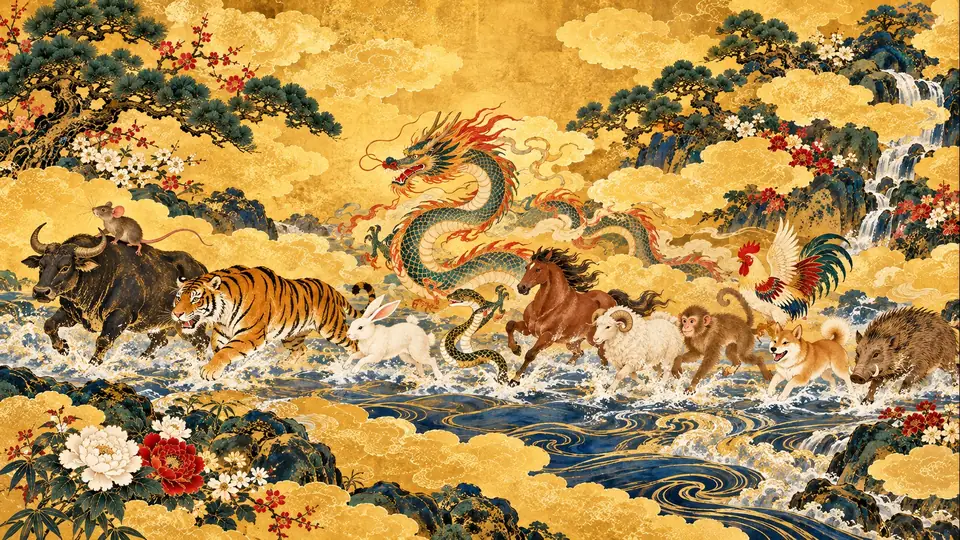
One New Year’s Eve, the story goes, the god announced that the first twelve animals to reach him on New Year’s morning would each rule a year. The slow ox set off the night before, and the rat, riding secretly on its back, jumped down at the gate to arrive first. The cat had forgotten the date; the rat told it “the second of January”, so it arrived too late, and it has chased rats ever since. Versions of the tale are told all over Japan.
4.Directions and hours too
The branches are also assigned to directions, hours and months. North is the Rat (子) and south the Horse (午), so the north–south line is called shigosen, the “Rat–Horse line”, the Japanese word for a meridian. The middle of the Horse hour (11:00–13:00) is shōgo, “noon”, and the words for a.m. and p.m., gozen and gogo, literally mean “before the Horse” and “after the Horse”.
5.How the branches relate to each other
Branches have relationships of harmony and conflict: the trines (sangō), the six pairings (shigō), clashes (chū), punishments, harms and breaks. See the twelve-animal compatibility chart for every pair.
6.FAQ
Why is there no cat among the twelve animals?
In the folk tale, the rat told the cat the wrong day for the gathering, so it missed its chance. In the Vietnamese zodiac, the cat takes the place of the rabbit.
How do people remember the order?
Japanese children chant it: ne, ushi, tora, u, tatsu, mi, uma, hitsuji, saru, tori, inu, i. In English: Rat, Ox, Tiger, Rabbit, Dragon, Snake, Horse, Goat, Monkey, Rooster, Dog, Pig.
Now try a reading for yourself
Free readings related to this article.
Read next