The ten stems (jikkan)
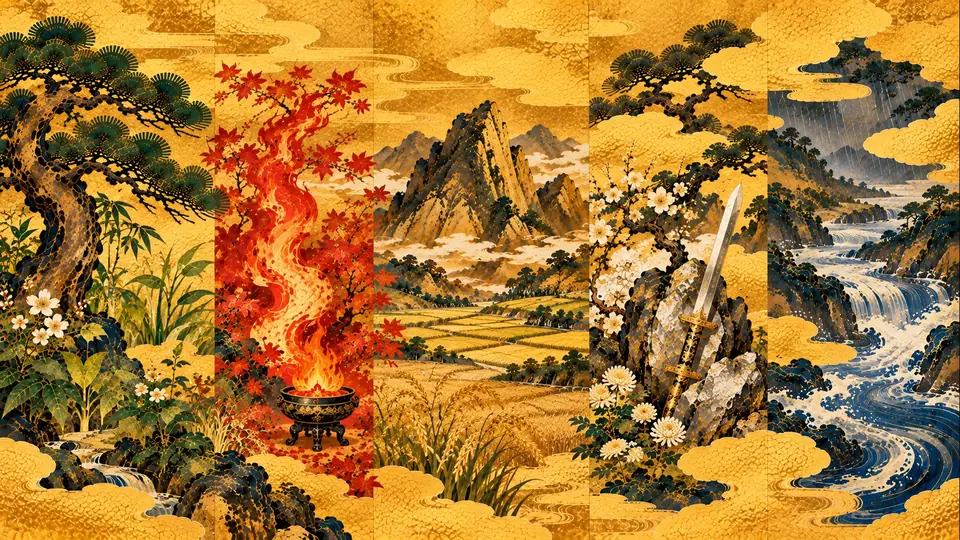
The ten stems are said to have begun in ancient China as names for the days of a ten-day “week”, the jun (旬). The Japanese words for the first, middle and last ten days of a month, jōjun, chūjun and gejun, still carry that trace.
On this page
1.The ten stems
| Stem | Japanese reading | Sino-Japanese | Element | Yin/Yang | Image |
|---|---|---|---|---|---|
| 甲 | Kinoe | kō | Wood | Yang | A great tree |
| 乙 | Kinoto | otsu | Wood | Yin | Grasses and flowers |
| 丙 | Hinoe | hei | Fire | Yang | The sun |
| 丁 | Hinoto | tei | Fire | Yin | A lamp flame |
| 戊 | Tsuchinoe | bo | Earth | Yang | A mountain |
| 己 | Tsuchinoto | ki | Earth | Yin | Fields and gardens |
| 庚 | Kanoe | kō | Metal | Yang | Iron and the sword |
| 辛 | Kanoto | shin | Metal | Yin | Jewels and precious metal |
| 壬 | Mizunoe | jin | Water | Yang | The ocean and great rivers |
| 癸 | Mizunoto | ki | Water | Yin | Rain and dew |
2.Stems, elements and yin and yang
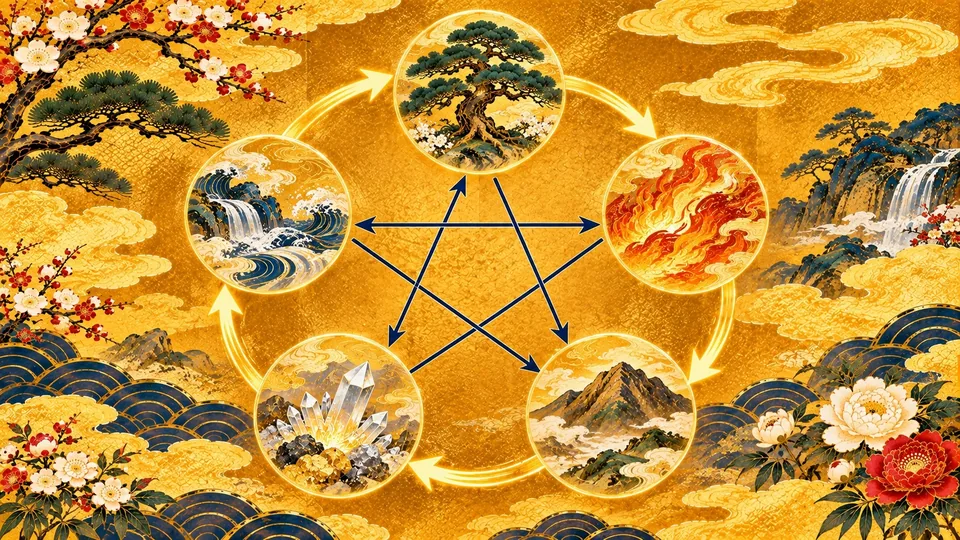
Each of the five elements, wood, fire, earth, metal and water, is split into a yang “elder brother” (e) and a yin “younger brother” (to). That is why 甲, kinoe, means “elder brother of wood”, and 乙, kinoto, “younger brother of wood”.
3.The life of a plant
The Book of Han matches each stem to a stage in a plant’s life, from the shoot breaking its husk to the seed that carries the next generation. 甲 is the shoot splitting its shell, 乙 the shoot bending as it grows, 丙 the plant taking clear shape, and so on: the stems are also a picture of the cycle of life.
4.Where the stems still appear
- Contracts: Japanese contracts call the two parties 甲 and 乙, like “Party A” and “Party B”
- Grades: old school reports and conscription tests graded people 甲, 乙, 丙
- The phrase kōotsu tsukegatai, “hard to rank as 甲 or 乙”, means two things are equally good
- Kōshien Stadium was completed in 1924, a 甲子 (Kinoe-ne) year
Each stem’s personality is described on the ten stems page. To find your own stem (your day stem), use the birth chart reading.
Now try a reading for yourself
Free readings related to this article.
Read next