
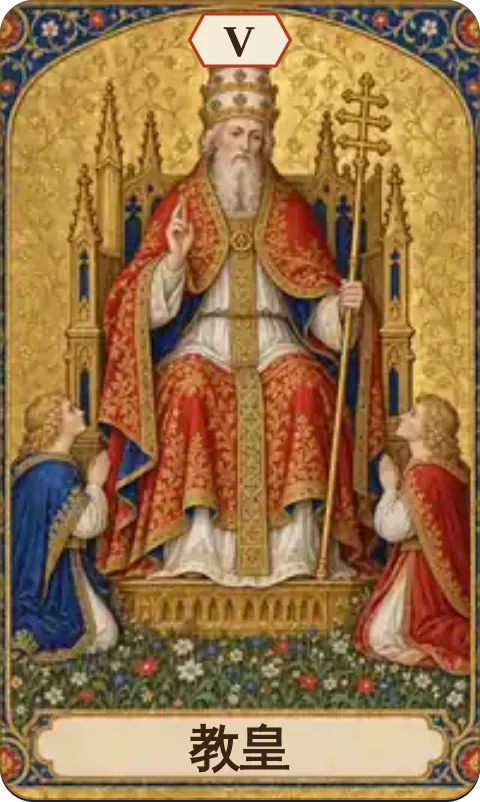
The Hierophant
Learn from wisdom handed down and from teachers you can trust. Sincerity and doing things properly build real trust and peace of mind.
- Card
- Major Arcana · V
- Upright keywords
- Trust, Tradition, Teaching, Integrity
- Reversed keywords
- Empty formality, Distrust, Isolation, Unconventionality
- Yes or no
- Leans yes
Traditional correspondences Hebrew letter: Vav (ו, nail) / Astrology: Taurus / Tree of Life: 16th path (Chokmah to Chesed) / Element: Earth
Upright meaning
Advice from someone you trust, and an honest approach, open the way.
The Hierophant sits between two pillars, raising his hand in blessing over two kneeling followers. He is the teacher, the keeper of tradition and the bridge between everyday life and something greater. Upright, this card favours tried-and-tested paths: learning from a mentor, joining a community, following proper procedures, honouring commitments. It can point to education, formal ceremonies such as weddings, or the support of an institution. There is comfort in belonging and in wisdom that has stood the test of time.
Reversed meaning
Too bound by form, or quick to lose trust. Speak honestly and from the heart.
Reversed, tradition can feel like a cage. Rules may be followed for their own sake, a teacher or institution may let you down, or you may feel you don’t fit in. The reversal can also be a healthy questioning of what you were taught, a sign that you are ready to find your own beliefs. Ask which rules still serve you and which you can respectfully set aside.
For ways of reading reversed cards, see how to read reversals.
Love
A traditional, committed relationship, often heading towards engagement or marriage.
A relationship held together by duty, or partners with different values. Talk about what you truly want.
Work
Good for established organisations, training, qualifications and following the rules.
Bureaucracy or a workplace culture that stifles you. Look for ways to bring in fresh ideas.
Money
Conventional, reliable choices: banks, pensions, expert advice.
Bad advice or an inflexible system. Get a second opinion.
Relationships
Mentors, communities and shared values bring people together.
Feeling excluded, or pressure to conform. Find people who accept you as you are.
Health
Sticking to sensible routines and following professional advice.
Rigid habits that no longer help. Be open to a different approach.
Tarot does not diagnose physical conditions. If you have symptoms that worry you, please see a doctor.
Mind and spirit
Faith, ritual or a spiritual community supports you.
Questioning beliefs you inherited. It is fine to grow your own.
As a person
A teacher, mentor, counsellor or someone who represents an institution.
Someone dogmatic and preachy, or a rebel who rejects all rules.
Timing
Things go through formal steps, so expect steady but slow progress over weeks to months. Ceremonies and official events can be turning points.
Advice
Seek out a trusted teacher and follow the proper steps.
Keep what is useful from tradition, and trust your own values too.
Questions to ask yourself
- Who or what should I learn from right now?
- Are the “shoulds” I follow really my own values?
- What wisdom or experience can I pass on to someone?
A common misreading
The Hierophant is often thought old-fashioned or stiff, but upright it is the security of trustworthy teaching, companions and proper procedure. It isn’t only about religion; it covers the wisdom of any community, such as a school, workplace or family. Reversed, it isn’t mere rebellion either; it can be a stage of growing your own beliefs.
The story of this card
Having learned worldly order from the Emperor, the traveller kneels before the Hierophant. Five is the number of movement and of bridging, born when one is added to the stable four, and here it means connecting the seen and unseen worlds. If the Emperor rules outward law, the Hierophant passes on the law of the heart: morality, faith and teachings handed down in a community. The traveller learns to learn from those who walked ahead, and to share values with companions.
The Waite deck’s picture and symbols
In the Waite deck the Hierophant wears a triple crown and red robes and sits between two grey pillars. His right hand is raised in blessing; his left holds a triple cross. Two crossed keys lie at his feet, the keys to heaven, and two tonsured monks kneel before him, one wearing roses and one lilies.
History and differences between traditions
In Italian decks this card was “il Papa”, the Pope, partner to the female pope. Protestant and later French decks sometimes replaced him with other figures, such as Jupiter or Bacchus, to avoid religious offence. The Golden Dawn named him the Hierophant, after the high priest who revealed the sacred mysteries at Eleusis, and the Waite deck followed.
Words for today
I learn gladly from those who came before me.
I trust the values that are truly mine.