
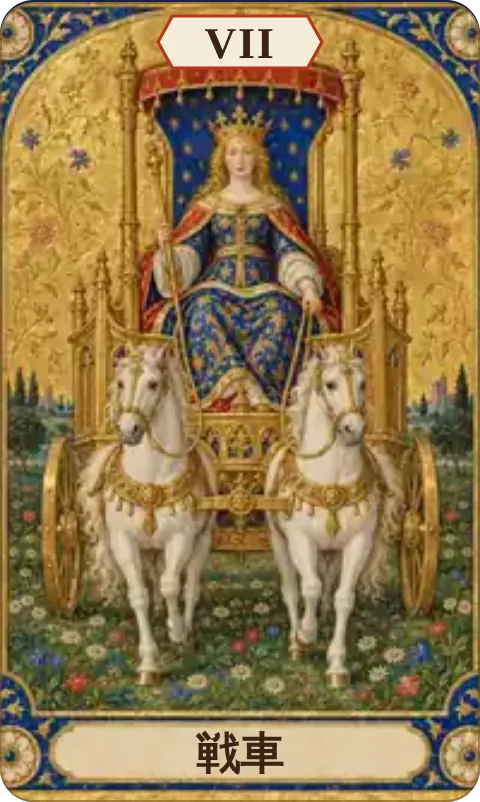
The Chariot
Bring opposing feelings together with willpower and drive towards your goal. Even with doubts on board, hold the reins and victory comes closer.
- Card
- Major Arcana · VII
- Upright keywords
- Progress, Victory, Willpower, Action
- Reversed keywords
- Losing control, Setbacks, Impatience, Losing direction
- Yes or no
- Leans yes
Traditional correspondences Hebrew letter: Cheth (ח, fence) / Astrology: Cancer / Tree of Life: 18th path (Binah to Geburah) / Element: Water
Upright meaning
Push on with determination and victory is yours. Now is the time to move forward.
A charioteer in armour stands in a chariot drawn by two sphinxes, one black and one white, each wanting to go its own way. He holds no reins; he steers by willpower alone. Upright, the Chariot is a card of momentum and success through focus. You know where you want to go, and you have the drive to get there. Conflicting desires or obstacles won’t stop you if you keep your eyes on the goal. It can also mean travel, a move or literally getting behind the wheel.
Reversed meaning
Your energy is spinning out and you’re losing your way. Take hold of the wheel again.
Reversed, the Chariot’s energy runs out of control or stalls. You may be pushing too hard, getting angry when things don’t go your way, or pulled in two directions until you get nowhere. Sometimes the reversal shows a setback that forces you to stop and rethink your route. Slow down, decide on one direction and regain control before you set off again.
For ways of reading reversed cards, see how to read reversals.
Love
Pursuing someone with confidence, or a relationship that moves forward quickly.
Power struggles, or one person rushing ahead. Agree on where you’re heading together.
Work
Winning a competition, hitting a target or getting ahead through drive.
Burning out from pushing too hard, or a project that’s veered off course.
Money
Disciplined effort brings financial gains. Stay focused on your goal.
Rash decisions or spending to keep up. Steady your course.
Relationships
Taking the lead and rallying others behind a common aim.
Clashes of will. Winning the argument isn’t worth losing the relationship.
Health
Strong drive and energy. Good for setting fitness goals.
Overdoing it, or stress-related tension. Pace yourself.
Tarot does not diagnose physical conditions. If you have symptoms that worry you, please see a doctor.
Mind and spirit
Mastering yourself by holding opposing forces in balance.
Feeling pulled apart. Find what you truly want to steer towards.
As a person
A determined, ambitious person who knows what they want.
Someone aggressive, impatient or directionless.
Timing
Once things start moving they move fast, with results within days or weeks. Travel or a move may set things off.
Advice
Set your direction and move forward with focus.
Ease off the accelerator and take back control.
Questions to ask yourself
- Where do I really want to go?
- What two feelings inside me are pulling in different directions?
- What do I value more than winning?
A common misreading
The Chariot is often thought to mean winning by force, but its true victory comes not from beating others but from self-mastery: bringing your own opposing forces together. Importantly, it shows someone holding the reins while still carrying doubts, not someone with no doubts. It can be read as travel or a car, but that is only one of many meanings.
The story of this card
Having learned from the Lovers to choose by their heart, the traveller climbs into the Chariot carrying that choice. Seven is the number of challenge, achievement and the close of a stage. In the tradition that divides the Major Arcana into three stages, the Chariot is the end of the first: establishing yourself in the outer world. Here the traveller learns to unite opposing impulses by will and press towards a goal. With victory in hand, they move on to Strength, and an inner journey.
The Waite deck’s picture and symbols
In the Waite deck the charioteer wears a starry crown and a breastplate with a square, a symbol of will. Crescent moons sit on his shoulders. His canopy is spangled with stars, and the two sphinxes, black and white, sit before the chariot. A walled city lies behind him: he has left the safety of home to advance into the world.
History and differences between traditions
Early Italian decks showed a triumphal procession, often a crowned woman or a victorious general in a chariot drawn by horses, inspired by Renaissance pageants. The Marseille deck kept the horses. The French occultist Éliphas Lévi introduced the black and white sphinxes, and Waite followed him.
Words for today
I hold my course with a steady will.
I can slow down and still arrive.