The history of yin-yang and the five elements
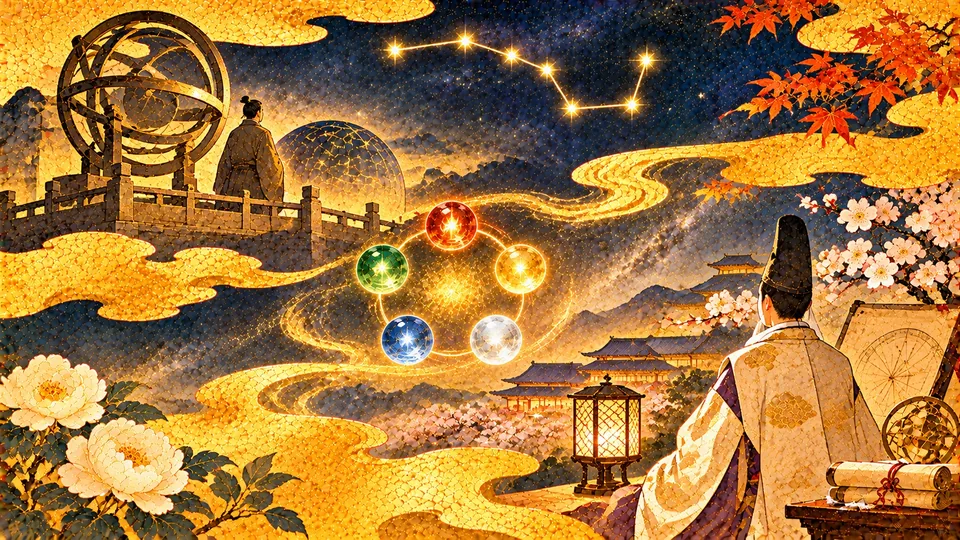
Yin-yang thought and five-element thought began separately and were joined in China during the Warring States period. The combined theory then travelled to Japan, where it grew its own branches in the calendar, the festival year and the practice of Onmyōdō.
On this page
1.Ancient China: the birth of yin-yang and the five elements
Yin and yang were worked into a theory in the commentaries on the Book of Changes (the “Ten Wings”, especially the Great Commentary), written between the Warring States period and the Han dynasty, and became closely tied to divination with the I Ching. The five elements, meanwhile, appear in the “Great Plan” chapter of the Book of Documents: “first, water; second, fire; third, wood; fourth, metal; fifth, earth.”
Around the 3rd century BC, the thinker Zou Yan of the state of Qi explained the rise and fall of dynasties as a cycle of the five elements. From this time on, yin-yang and the five elements were spoken of as a single system. In the Han dynasty, Dong Zhongshu and others joined it with Confucianism, and it became a foundation of state institutions and the calendar.
2.Arrival in Japan
Yin-yang five-element theory reached Japan via the Korean peninsula around the 6th century, together with Buddhism and calendar-making. The Nihon Shoki records that in 602 the Baekje monk Kwalleuk brought books on the calendar, astronomy and geography and on divination, and had students learn from them.
In the late 7th century, under Emperor Tenmu, the Onmyōryō, the Bureau of Onmyō, was founded. It was the government office in charge of divination, astronomy, the calendar and timekeeping, and the onmyōji who worked there were civil servants.
3.The Heian period: the age of the onmyōji
By the Heian period, onmyōji had become indispensable to aristocratic life. Daily actions were governed by Onmyōdō: katatagae, taking a detour to avoid an unlucky direction; days of ritual seclusion; purifications.
The most famous is the legendary Abe no Seimei (921–1005). His descendants, the Abe family (later the Tsuchimikado), together with the Kamo family, carried on the work of Onmyōdō for generations.
4.The Edo period: the calendar and ordinary life
In 1684 the shogunate adopted the Jōkyō calendar, Japan’s own calendar made by Shibukawa Harumi, which came into use the following year. Calendars were printed with almanac notes marking lucky and unlucky days, and ordinary people lived by them, keeping the Kōshin vigil and Kinoe-ne days and facing the year’s lucky direction. The Hinoe-uma superstition spread at this time too.
5.From the Meiji era to today
The Bureau of Onmyō was abolished in 1870, and the calendar reform of 1872 brought in the solar (Gregorian) calendar from 1 January 1873. Yet the eto, the 24 solar terms, Nine Star Ki and the rokuyō all survive in today’s calendars, and still live on in everyday life.
Now try a reading for yourself
Free readings related to this article.
Read next