The winter solstice (Tōji)
Tōji (冬至), one of the 24 solar terms, is the day with the shortest daylight and the longest night of the year in the northern hemisphere. It is the moment the sun reaches 270° of ecliptic longitude, and the day (in Japan time) that contains that moment is the day of the solstice.
On this page
The next winter solstice is Dec 22 (Tue), 2026, at 5:50 Japan time.
1.Dates and times of the winter solstice
| Year | Winter solstice | Time (JST) |
|---|---|---|
| 2026 | Dec 22 (Tue) | 5:50 |
| 2027 | Dec 22 (Wed) | 11:42 |
| 2028 | Dec 21 (Thu) | 17:19 |
| 2029 | Dec 21 (Fri) | 23:14 |
| 2030 | Dec 22 (Sun) | 5:09 |
| 2031 | Dec 22 (Mon) | 10:55 |
The moment the sun reaches 270° of ecliptic longitude, in Japan Standard Time.
In Tokyo, the day of the winter solstice has about 9 hours 45 minutes of daylight, some 4 hours 50 minutes less than at the summer solstice. Curiously, the earliest sunset comes before the solstice (in early December) and the latest sunrise after it (in early January).
2.Ichiyō raifuku: the return of the light
The winter solstice is the day yin reaches its peak and turns to yang, a moment called ichiyō raifuku, “one yang returns”, because from then on the days grow longer again. The phrase comes from the fu (“return”) hexagram of the Book of Changes. Some ancient Chinese calendars, such as that of the Zhou, began the year at the winter solstice. Even today, the month containing the solstice (from Taisetsu to the day before Shōkan) is the Rat month, the first of the branches.
3.Yuzu baths
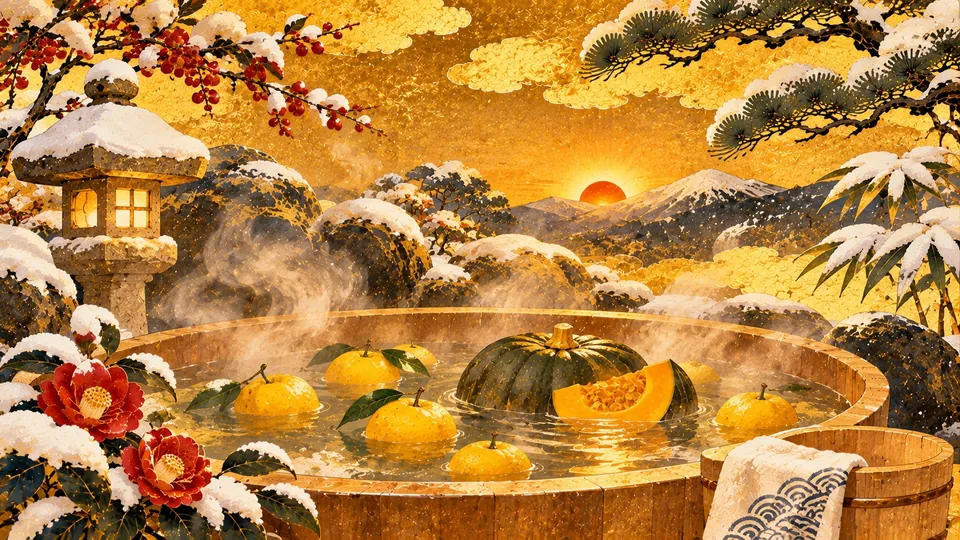
A bath with yuzu citrus floating in it on the day of the solstice is said to keep colds away. The custom is thought to have spread from Edo-period public baths, and is said to be a pun: tōji (solstice) and tōji (a curative soak), yuzu and yūzū (flexibility, getting on smoothly).
4.Pumpkin and “n” foods
Many parts of Japan eat pumpkin (nankin) at the solstice. Harvested in summer and good for storing, it was a source of nutrition in the vegetable-poor winter. Foods with two “n” sounds, such as nankin, ninjin (carrot), renkon (lotus root), ginnan (ginkgo nuts), kinkan (kumquat), kanten (agar) and undon (udon), are called “the seven foods of the solstice”, and are said to bring in un, luck. Some regions eat red-bean porridge to ward off misfortune.
5.Spending the solstice
The solstice is the doorway to the real cold. Warm up in a yuzu bath, eat seasonal vegetables and get yourself in shape for the end of the year. After the solstice comes New Year: see next year’s eto and how to display eto ornaments.
Now try a reading for yourself
Free readings related to this article.
Read next