Shichi-go-san age chart and choosing a date
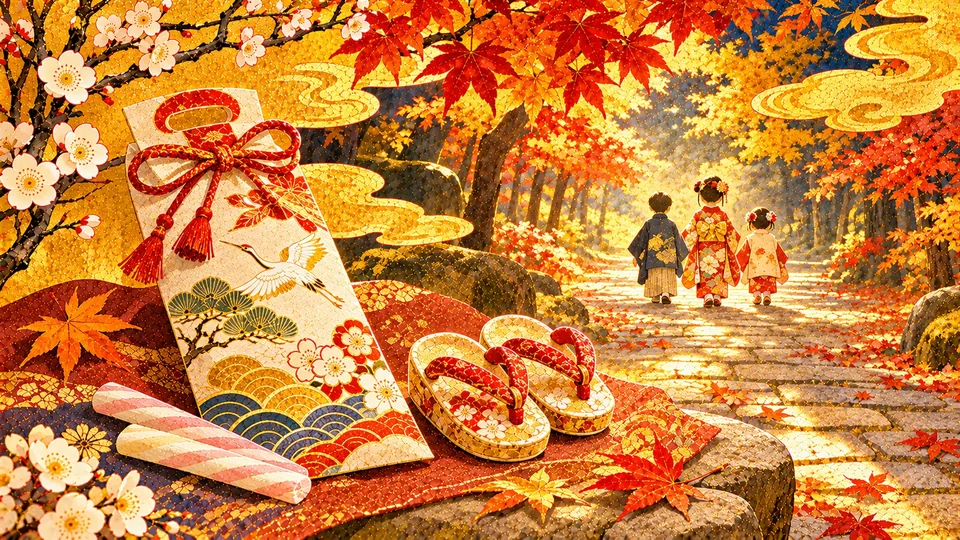
Shichi-go-san, “seven-five-three”, is the day children are taken to a shrine to give thanks for their growth. Boys usually celebrate at 3 and 5, girls at 3 and 7. It used to be counted in kazoe age (where you are 1 at birth and add a year every New Year), but many families now use full age, and either is fine.
On this page
1.Shichi-go-san chart for 2026 and 2027
| Year | Age | By kazoe age | By full age |
|---|---|---|---|
| 2026 | 3 (boys and girls) | Born in 2024 | Born in 2023 |
| 2026 | 5 (boys) | Born in 2022 | Born in 2021 |
| 2026 | 7 (girls) | Born in 2020 | Born in 2019 |
| 2027 | 3 (boys and girls) | Born in 2025 | Born in 2024 |
| 2027 | 5 (boys) | Born in 2023 | Born in 2022 |
| 2027 | 7 (girls) | Born in 2021 | Born in 2020 |
In kazoe age you are 1 in the year you are born and add a year every New Year. Full age is shown as the birth year of children who turn 3, 5 or 7 during that year (some will not have had their birthday yet on 15 November).
Some families mix the two counts so that brothers and sisters can celebrate together. Children born between January 1 and April 1 are a school year ahead of others born in the same calendar year, so some use kazoe age to celebrate with their classmates.
2.Why November 15?
The story goes that on November 15, 1681, the shōgun Tokugawa Tsunayoshi celebrated the kamioki of his eldest son Tokumatsu, then aged three by kazoe count (the sources differ on exactly which rite it was). November 15 of the old lunar calendar also fell on Kishuku, one of the 27 lunar mansions, the most auspicious of them all, said to be good for anything except weddings. The eleventh lunar month was also when people thanked the gods for the harvest, and one theory says the custom began with telling the local deity about the children’s growth on that month’s full moon. After Japan changed to the Western calendar in 1873, the date moved to November 15 of the new calendar.
3.The rites at 3, 5 and 7
- Kamioki (“leaving the hair”), at 3: the child, boy or girl, stops having their head shaved and starts growing their hair.
- Hakamagi (“putting on the hakama”), at 5: a boy wears the pleated hakama trousers for the first time.
- Obitoki (“untying the cords”), at 7: a girl moves from a kimono tied with cords to one fastened with a proper obi sash.
The ages were not fixed at first. Among the court nobility, both boys and girls had their hakamagi at around 3 to 7, and obitoki was originally for boys and girls at around 9. In the mid-Edo period the pattern of hakamagi for boys at 5 and obitoki for girls at 7 settled, and from the Meiji era these samurai and townsfolk customs spread across the country.
4.Choosing a day
Few families keep strictly to November 15 now; most go on a weekend or public holiday between mid-October and late November. Some choose a Taian day in the rokuyō, or a lucky day such as Tenshabi or Ichiryū-manbai-bi. You can also think in terms of time of day: Senshō days are lucky in the morning, Senbu days in the afternoon.
Taian days on weekends and holidays
- 2026 (from now on): Nov 22 (Sun), Nov 28 (Sat; also Fujōju-bi) (15 November is a Sunday, Butsumetsu)
- 2027: Oct 30 (Sat), Nov 23 (Tue, Labor Thanksgiving Day), Nov 28 (Sun) (15 November is a Monday, Senbu)
Weekends and holidays from 15 October to 30 November that are Taian. Days that also fall on Fujōju-bi or Jushi-bi are noted.
It is also increasingly common to take the photos in summer or early autumn and to visit the shrine on a quiet weekday.
Now try a reading for yourself
Free readings related to this article.
Read next