The five seasonal festivals, the eto and yin-yang
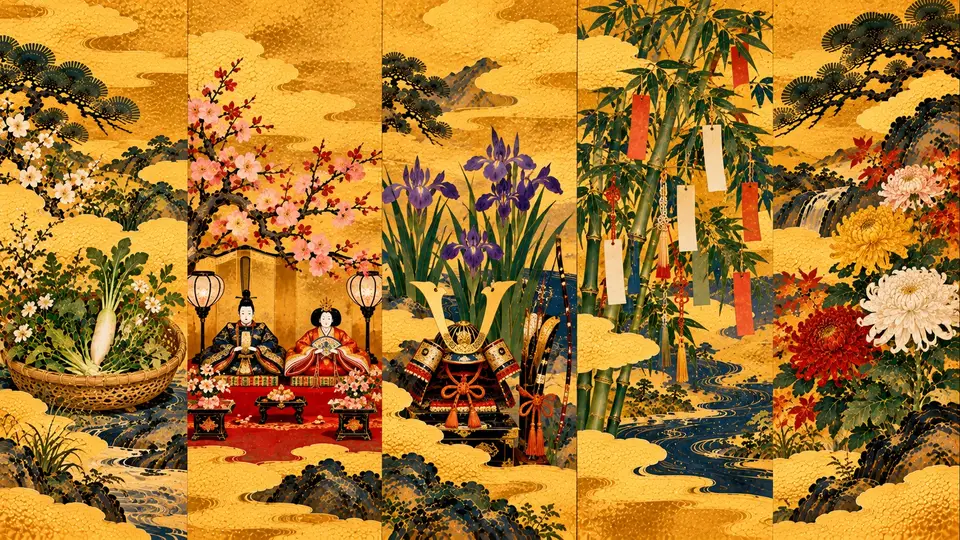
The five sekku are festivals held at the turning points of the seasons to drive away evil and pray for health. They fall on days where an odd (yang) number repeats, except in January, where New Year’s Day stands apart and the 7th, Jinjitsu, is used instead. One theory says that when yang doubles up it easily turns to yin, so these days call for warding off bad luck. China long treated the fifth month as an unlucky month: the 6th-century Jingchu Suishiji records picking mugwort on the 5th day of the 5th month and hanging it on the gate to keep evil out. In Japan, the Tokugawa shogunate made the five sekku official holidays, which spread them from the samurai to ordinary people, and though they were abolished as holidays in 1873 they live on as folk festivals.
| Festival | Date | Other name | Custom |
|---|---|---|---|
| Jinjitsu (人日) | 7 January | Festival of the Seven Herbs | Eating seven-herb rice porridge |
| Jōshi (上巳) | 3 March | Peach Festival | Displaying hina dolls (Girls’ Day) |
| Tango (端午) | 5 May | Iris Festival | Carp streamers, iris baths (Children’s Day) |
| Shichiseki (七夕) | 7 July | Bamboo Festival (Tanabata) | Writing wishes on paper strips |
| Chōyō (重陽) | 9 September | Chrysanthemum Festival | Drinking chrysanthemum sake |
Jōshi was “the first Snake day”
Jōshi originally meant the first Snake day (巳) of the third lunar month; it is said to have been fixed on the 3rd of the month from around the Wei dynasty. The custom of purifying oneself by the water on this day became nagashi-bina, setting dolls carrying one’s impurities adrift on a river, and that grew into the doll festival.
Tango was “the Horse day of the Horse month”
The tan of Tango means “first”, and the word once meant the first Horse day (午) of a month. Tango was the first Horse day of the fifth lunar month, which is the Horse month in the twelve branches. Because 午 (go, Horse) sounds the same as 五 (go, five), it is said to have settled on 5 May.
Chōyō doubles the highest yang number
On 9 September the highest yang number, 9, doubles, making it a day of especially strong yang. People drank sake with chrysanthemum petals floating in it to pray for a long life.
The date of a baby’s first festival can be found together with other milestones in shrine visit and first-meal dates.
Now try a reading for yourself
Free readings related to this article.
Read next