What is Western astrology?
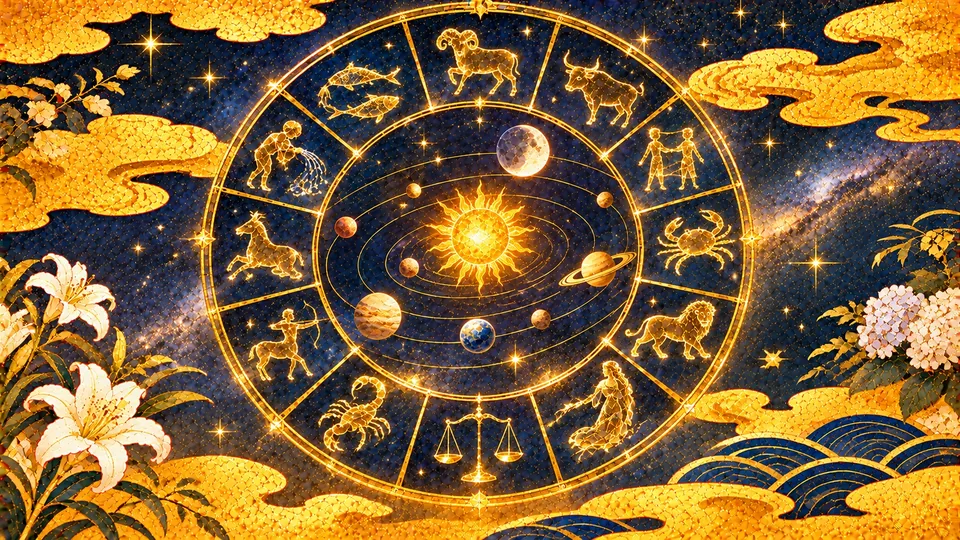
Western astrology draws the positions of the Sun, Moon and planets at the moment of your birth on a circular chart, the horoscope, and reads your character and destiny from it. It began with sky omens in Mesopotamia; the horoscope form took shape in Hellenistic Egypt and was set out as a system in Ptolemy’s Tetrabiblos in the 2nd century. It then reached us by way of the Islamic world and medieval Europe.
On this page
1.A sign is one twelfth of the ecliptic
The path the Sun traces across the sky over a year is called the ecliptic. Western astrology divides it into twelve 30° sections starting from the spring equinox point, and calls each one of the 12 signs. The idea of dividing the ecliptic into twelve 30° parts arose in Babylonia around the 5th century BCE. The signs share their names with constellations in the night sky, but because they are fixed to the seasons (the tropical zodiac), they are now about 24° (nearly one sign) away from where the actual constellations are.
2.Four elements and three modes
| Element | Signs | Nature |
|---|---|---|
| Fire | Aries, Leo, Sagittarius | Passion, action, intuition |
| Earth | Taurus, Virgo, Capricorn | Reality, stability, the senses |
| Air | Gemini, Libra, Aquarius | Intellect, connection, thought |
| Water | Cancer, Scorpio, Pisces | Feeling, empathy, receptivity |
The signs are also divided into cardinal signs, which start a season (Aries, Cancer, Libra, Capricorn), fixed signs at the height of a season (Taurus, Leo, Scorpio, Aquarius), and mutable signs at the turn of a season (Gemini, Virgo, Sagittarius, Pisces).
3.The four elements of the West and the five of the East
The Fire, Earth, Air and Water of Western astrology come from the ancient Greek theory of four elements. They are a separate system from the Eastern five elements (Wood, Fire, Earth, Metal, Water), but both share the idea of seeing the world through the qualities of a few kinds of energy or element.
4.The ten planets
Astrology uses ten bodies: the seven of the Sun, Moon, Mercury, Venus, Mars, Jupiter and Saturn, plus Uranus, Neptune and Pluto, discovered in modern times. Their meanings are explained in the meanings of the planets.
5.Sun sign, Moon sign and rising sign
- Sun sign: the sign the Sun was in when you were born. This is the “star sign” of magazine horoscopes. It shows your sense of self and your purpose in life.
- Moon sign: the sign the Moon was in when you were born. It shows your emotions, your private self and what gives you peace of mind. The Moon changes sign about every two and a half days, so it can depend on the time you were born.
- Rising sign (ascendant): the sign where the eastern horizon met the ecliptic at the moment of birth. It shows your first impression, your appearance and how you approach life. It needs an exact time and place of birth.
Find your Sun, Moon and rising signs with the zodiac reading (Japanese).
6.The twelve houses
The chart is divided into twelve sections starting from the rising sign, called houses, each standing for an area of life (the 1st house is the self, the 2nd money, the 7th marriage and partners, the 10th career and status, and so on). There are several house systems: Placidus is the most common in Japanese magazines and software, Whole Sign (the whole sign of the ascendant is the 1st house) is used in classical and Indian astrology, and there are others such as Equal and Koch.
7.Aspects
The angles the planets make with each other are called aspects. The major aspects are 0° (conjunction), 60° (sextile), 90° (square), 120° (trine) and 180° (opposition).
Now try a reading for yourself
Free readings related to this article.
Read next