What is Indian astrology (Jyotish)?
Indian astrology is called Jyotish, “the science of light”, in Sanskrit. It began as one of the auxiliary sciences of the Vedas, the study of the calendar, and later merged with horoscopic astrology from the Greek world (over two thousand years old as calendar science, and in horoscope form since around the 2nd century CE). In India it is still widely used today to choose dates for weddings and for opening a business.
On this page
1.The biggest difference from Western astrology: the sidereal zodiac
Western astrology uses the tropical zodiac, measured from the spring equinox, while Indian astrology uses the sidereal zodiac, measured from the actual positions of the stars. Because of the precession of the Earth’s axis, the two are now about 24° apart, almost a whole sign. This difference is called the ayanamsha. This site uses the widely used Lahiri ayanamsha (adopted by the Indian government). There are other schools, such as KP and Raman, and if your Moon is close to the boundary of a nakshatra or rashi, the result can change with the method.
So many people who are Taurus in Western astrology are the sign before, Aries (Mesha), in Indian astrology.
2.The Moon comes first
Western astrology puts the weight on the Sun sign; Indian astrology puts it on the Moon sign (rashi) and the lagna, the sign rising in the east at the moment of birth.
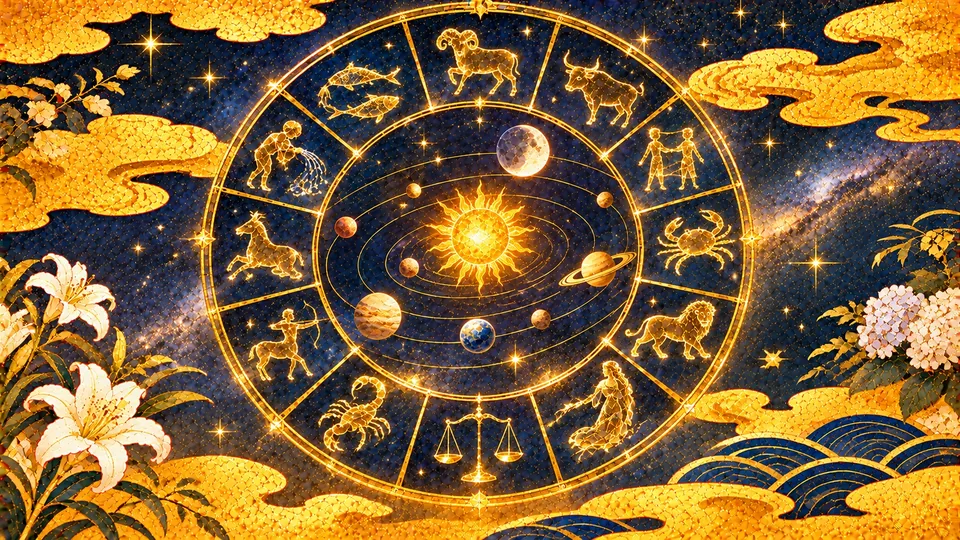
| Rashi | Corresponding sign | Ruling planet |
|---|---|---|
| Mesha | Aries | Mars |
| Vrishabha | Taurus | Venus |
| Mithuna | Gemini | Mercury |
| Karka | Cancer | Moon |
| Simha | Leo | Sun |
| Kanya | Virgo | Mercury |
| Tula | Libra | Venus |
| Vrishchika | Scorpio | Mars |
| Dhanu | Sagittarius | Jupiter |
| Makara | Capricorn | Saturn |
| Kumbha | Aquarius | Saturn |
| Mina | Pisces | Jupiter |
3.The 27 nakshatras
The Moon goes round the sky in about 27.3 days. Indian astrology divides the ecliptic into 27 parts of 13°20′ each and finds your nakshatra (lunar mansion) from where the Moon was. China had long had its own 28 lunar mansions, but the Tang-dynasty Sutra of Mansions and Planets (Sukuyōkyō) followed the Indian system and used 27, leaving out the Ox mansion. This was handed down in Japan’s esoteric Buddhism as Sukuyō astrology. See the list of the 27 mansions and nakshatras.
4.Dasha: the periods of destiny
One feature of Indian astrology is the Vimshottari dasha, calculated from the nakshatra of your Moon at birth. It divides a 120-year life into periods ruled by nine planets, and reads the flow of your fortune from whichever planet’s period you are in now.
5.Rahu and Ketu
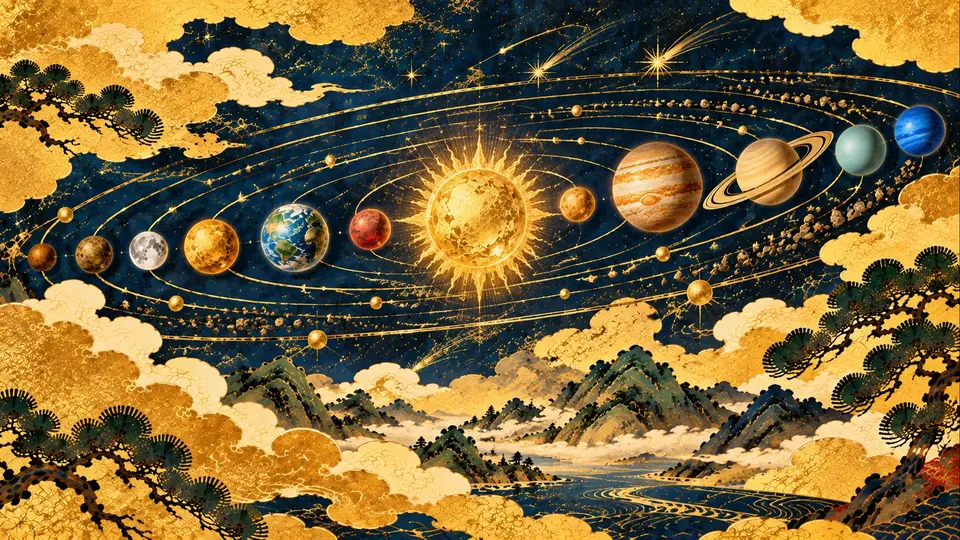
Indian astrology uses nine bodies, the navagraha: the seven of the Sun, Moon, Mars, Mercury, Jupiter, Venus and Saturn, plus Rahu (the north node) and Ketu (the south node), the points where the Moon’s orbit crosses the ecliptic. They are thought of as shadow planets that cause eclipses of the Sun and Moon.
Look up your Moon rashi and nakshatra with the Indian astrology reading (Japanese).
Now try a reading for yourself
Free readings related to this article.
Read next