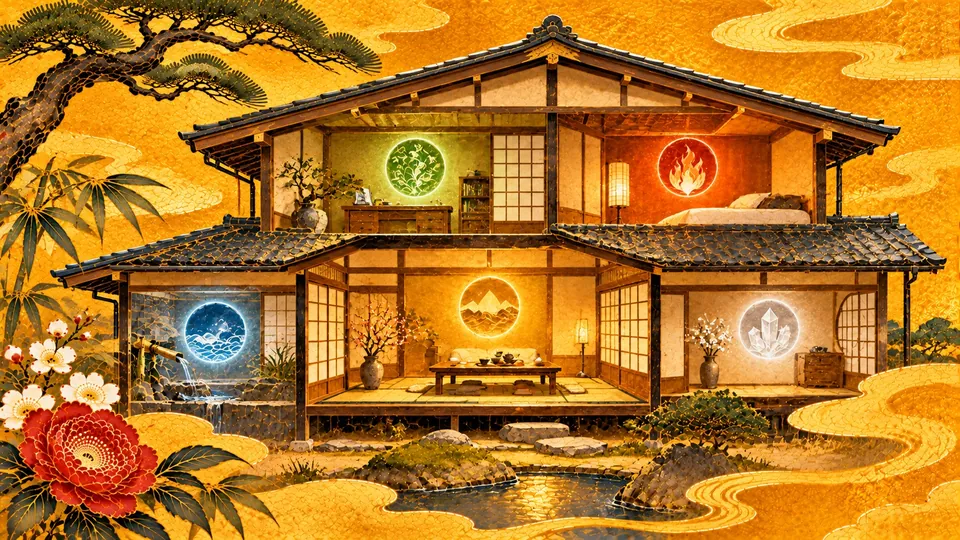
Feng shui by direction: the meaning and luck of the eight directions

Feng shui holds that each of the eight directions, seen from the center of the home, has its own meaning and area of luck. Matching how you use your rooms and furnish them to the directions is said to put the flow of qi in order.
On this page
1.How to measure the directions
- Get a floor plan of your home and find its center.
- Place a compass (a smartphone compass is fine) at the center and mark north on the plan.
- Draw lines out from the center to divide the plan into eight directions. There are two ways to divide it. Chinese feng shui (Eight Mansions and others) usually splits the eight directions evenly at 45° each. Japanese kasō and Nine Star Ki often use 30° each for north, east, south and west, and 60° each for northeast, southeast, southwest and northwest.
2.The eight directions at a glance
| Direction | Element | Meaning and luck | Lucky colors | Said to suit |
|---|---|---|---|---|
| North | Water | Trust, savings, love, children | White, pink, wine red | Indirect lighting, pink fabrics |
| Northeast | Earth | Change, inheritance, turning points | White, yellow | White pottery, morijio salt cones |
| East | Wood | Work, growth, youth, motivation | Red, blue, green | Houseplants, things that make sound |
| Southeast | Wood | Good matches, relationships, travel | Green, orange | Flowers, pleasant scents |
| South | Fire | Beauty, popularity, intuition, talent | Green, red, gold | Plants, lights |
| Southwest | Earth | Home, effort, stability | Yellow, brown, beige | Pottery, low plants |
| West | Metal | Money, enjoyment, romance | Yellow, white, gold | Yellow objects, round things |
| Northwest | Metal | Career, promotion, help from superiors | Beige, gold, white | Tasteful ornaments, clocks |
The elements in the table are the traditional pairing of directions with the five elements. The lucky colors, on the other hand, are an idea spread by Japanese feng shui books, and they vary by school and by author (for the colors of the elements themselves, see the table in feng shui by the five elements). The table shows one common set. The meaning of each color is explained in feng shui colors.
3.Tips for each direction
North: quiet and warm
North tends to be cold and dark. Add warmth with warm-colored lights and fabrics, and make it a quiet, settled space. It is also said to be a good direction for a bedroom.
Northeast and southwest: the demon gates
The northeast is called the “demon gate” (kimon) and the southwest the “rear demon gate” (ura-kimon), and Japanese kasō says these should be kept especially clean. If your toilet or front door is there, clean often and keep it bright. The origins are explained in directions and the eto.
East and southeast: morning sun and wind
East is where the morning sun comes in, and it stands for growth and development. Southeast is the direction of the “connections” the wind carries. Open the windows to let the breeze through, and put plants there.
South: brightness and beauty
South is the direction of the sun, standing for beauty, talent and popularity. A sunny south-facing room also tends to get cluttered, so tidy it and make the most of the light.
West and northwest: harvest and dignity
West is the direction of the setting sun, standing for harvest, money and enjoyment. Northwest is the direction of the head of the household and of superiors, and is said to suit a refined, calm style.
4.The center of the home
The center of the home is also called the taikyoku (the Great Ultimate), and is the linchpin of the whole home’s qi. It is important to keep it clear, without heavy or dirty things.
5.Directions for moving and travel
Separately from the directions inside your home, Nine Star Ki uses the star of your birth year to find good directions to travel in (lucky directions). Look up your main star and this year’s lucky directions with the Nine Star Ki reading.
6.FAQ
How do I find the center of my home?
A well-known method is to stick the floor plan onto card, cut it out, and find the point where it balances on a fingertip or pen tip. For homes with large projections or missing corners, schools differ on how to set the center.
Should I measure from magnetic north or true north?
Some schools use the north a compass points to (magnetic north) and others the north on a map (true north). In Japan magnetic north is a few degrees west of true north, so if it matters to you, follow your school’s approach.
Now try a reading for yourself
Free readings related to this article.
Read next