What is seimei handan (Japanese name divination)?
Seimei handan is Japanese name divination: it reads a person’s character and fortune from the number of strokes in the characters of their name. You combine the stroke counts of the family name and the given name into five “grids” (kaku), then read each number by the meaning of the numbers 1 to 81. In Japan it is used when naming babies, and when choosing pen names and shop names.
On this page
Try name divination for free (Japanese) →
1.A short history
The name divination most widely used in Japan today comes from the Kumazaki method, spread by Kumazaki Ken’ō with his book The Mystery of Names in 1929. There were older ideas of judging luck from the characters of a name, but it was the Kumazaki method that pulled together the five grids and the 81 numbers into one system.
The good and bad meanings of the 81 numbers are often traced to the 81-number scheme in the Hongfan Huangji Neipian by Cai Chen, a scholar of the Southern Song dynasty, and the system also draws on yin-yang and the five elements. Many schools have grown up since, and they count strokes and rate numbers differently. Numbers such as 26, 27, 30, 36, 38, 40 and 49, for example, are lucky or half-lucky in some schools and unlucky in others.
2.Working out the five grids
As an example, take the name 山田 花子 (Yamada Hanako). Counted in old forms by the Kumazaki method, 山 = 3, 田 = 5, 花 = 10 and 子 = 3.
| Grid | How to work it out | For Yamada Hanako | What it shows |
|---|---|---|---|
| Tenkaku (heaven grid, ancestral luck) | Total strokes of the family name | 3 + 5 = 8 | Luck inherited from your family |
| Jinkaku (person grid, main luck) | Last character of the family name + first character of the given name | 5 + 10 = 15 | Character, talents, luck in your prime |
| Chikaku (earth grid, early luck) | Total strokes of the given name | 10 + 3 = 13 | Childhood luck, the base of your character |
| Gaikaku (outer grid, secondary luck) | Total minus jinkaku (add a spirit number of 1 if a name has one character) | 21 − 15 = 6 | Relationships and help from others |
| Sōkaku (total grid, overall luck) | Total of every character | 3 + 5 + 10 + 3 = 21 | Lifelong luck, especially later life |
The most important are jinkaku and sōkaku. Tenkaku is the same for everyone in a family, so its meaning is not given much weight.
One-character names: the “spirit number”
When the family name or given name has only one character, as in 林 薫 (Hayashi Kaoru), you add a spirit number (reisū) of 1 to work out tenkaku or chikaku. The spirit number is not added to sōkaku. Some schools do not use it at all.
3.Counting strokes: old forms and new forms
Stroke counting is where results differ most.
- The Kumazaki method (old forms): each character is converted to its traditional pre-war form (沢 → 澤, 辺 → 邊, 広 → 廣 and so on), and radicals are counted by the strokes of the character they come from.
- New forms: you count the character exactly as it is written today.
In the Kumazaki method, radicals are counted like this.
| Radical | Original character | Strokes | Examples |
|---|---|---|---|
| 氵 (water) | 水 | 4 | 清 = 12, 海 = 11 |
| 扌 (hand) | 手 | 4 | 拓 = 9 |
| 忄 (heart) | 心 | 4 | 性 = 9, 慎 = 14 |
| 艹 (grass) | 艸 | 6 | 花 = 10, 菜 = 14 |
| 阝 on the left (mound) | 阜 | 8 | 陽 = 17 |
| 阝 on the right (village) | 邑 | 7 | 郎 (郞) = 14, 都 = 16 |
| 辶 (walk) | 辵 | 7 | 達 = 16, 道 = 16 |
| 王 (jewel) | 玉 | 5 | 琴 = 13 |
| 礻 (altar) | 示 | 5 | 祐 = 10 |
| 月 (flesh) | 肉 | 6 | 育 = 10 |
The numerals 一 to 十 are counted by the number they stand for, not their strokes, so 四 = 4, 五 = 5, 九 = 9. The repeat mark 々 in a name like 佐々木 is counted the same as the character before it here (schools differ). Only the radical position is converted to the original character: in 蓮, the grass radical counts 6 and the rest (連) 11, making 17, and the 辶 inside 連 is not converted because it is not the radical of 蓮.
4.The three-element arrangement and the yin-yang pattern
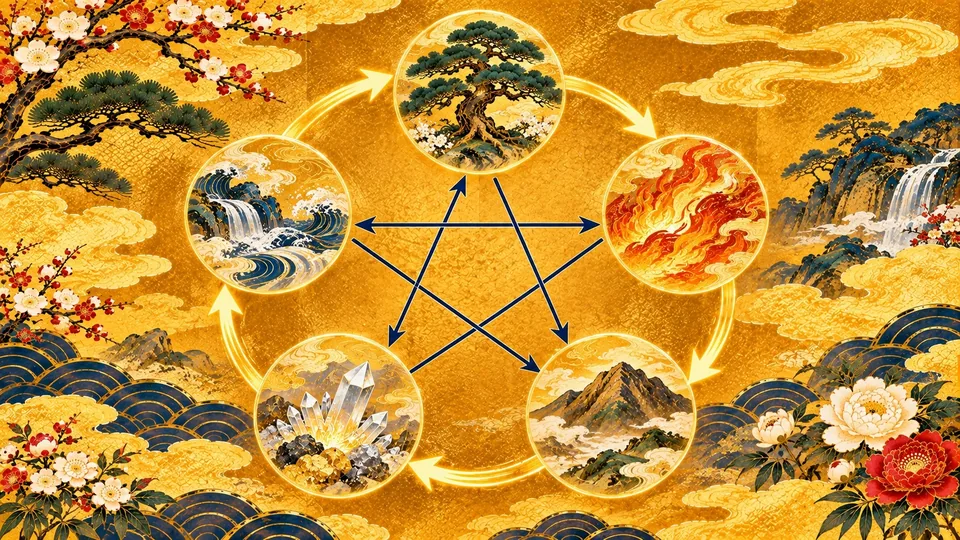
The three-element arrangement (sansai haichi) turns tenkaku, jinkaku and chikaku into the five elements and looks at how they connect. If the last digit of the number is 1 or 2 it is Wood, 3 or 4 Fire, 5 or 6 Earth, 7 or 8 Metal, and 9 or 0 Water. A flow from tenkaku to jinkaku to chikaku that is generating (one element feeding the next) or harmonious (the same element) is good, while a controlling link (one element suppressing another) calls for care. See the generating and controlling cycles.
The yin-yang pattern lines up each character’s stroke count as odd (yang) or even (yin). All the same, one kind sandwiched by the other, a long run of the same kind, or a clean split between family and given name are said to be unbalanced (schools differ).
5.Tips for using it when choosing a name
- Results change from school to school. Don’t decide on one result alone; weigh the sound, the meaning and how easy it is to write too.
- What matters most is jinkaku and sōkaku. It is hard to make every grid lucky, so deciding on priorities makes choosing easier.
- Japanese names can use hiragana, katakana, and the kanji approved for general use and for names.
- On the name divination page (Japanese), each name you try is added to a comparison table, which is handy for weighing up candidates.
6.FAQ
Why do different name divination sites give different results?
Schools differ in how they count strokes (old or new character forms, and whether radicals are counted as the original character), in whether they add the “spirit number”, and in how they rate the 81 numbers. Check which method a site uses before comparing.
Will an unlucky stroke count make me unhappy?
No. Name divination is one way of reading meaning into the numbers in a name; it does not decide your life. If a result bothers you, use it positively, for example through a nickname or a way of writing your name, or by taking heart from the good numbers.
Can a name in hiragana or katakana be read?
Yes. Kana have fixed stroke counts too (あ is 3, カ is 2 and so on). The usual rule is to add 2 for the voicing mark ゛ and 1 for the ゜ mark.
Now try a reading for yourself
Free readings related to this article.
Read next